
23 May 2022
Sustainability and ESG (environmental, social, and governance) factors are increasingly front of mind for many Asian investors. With governments and policymakers increasingly introducing new regulations around ESG issues, companies and portfolio managers have had to adapt accordingly. This cultural shift has taken place rapidly, however, leaving many investors playing catch-up. In this article, we’ll explain what ESG investing is and what it means for investors.

ESG investing is generally defined as any strategy that incorporates one or more environmental, social and governance factors in investment decisions and active ownership. While it can take many forms and may go under different names, including sustainable investing and socially responsible investing, these approaches all assume that the health of our natural environment, the strength of the social infrastructure in our communities, and the way companies are managed all play vital roles in creating value. Therefore, incorporating ESG risk analysis into research is an important tool to understand the true value of an investment, mitigating risk, and identifying new opportunities.
Let’s take a closer look at the three factors that make up ESG and how they might impact investment decisions:
As recognition of environmental risks such as climate change, loss of biodiversity, and other threats grow, society is increasingly penalizing polluters through taxes or regulatory change.
Companies with improving or better ESG performance will therefore be seen as having more sustainable business models. New products and services that can accelerate the transition to a cleaner, low-carbon economy could unlock significant business opportunities.
Companies face a risk of increased regulation and the alienation of valuable business partners, talent, and other stakeholders through mismanagement of these relationships. On the other hand, companies that best manage their relationships with stakeholders build robust value chains while remaining at the forefront of social change.
While firms can incur operational and disclosure-related costs as they engage in good corporate behaviour, they also stand to enjoy efficiency gains, greater trust from stakeholders, reduced firm-level tail risk, and other long-term benefits.
Environmental, social and governance: understanding the three factors of ESG
| Environmental | Social | Governance |
• Climate change | • Health and safety • Labor relations • Diversity • Human rights • Respect for the community • Other stakeholder expectations | • Board composition and oversight • Executive compensation: structure, performance metrics, and oversight • Minority shareholder rights protection • Capital management, dividend payouts, and dilution • Corporate actions (e.g., M&A) and corporate strategy |
Depending on the specific strategy, ESG investing can aim to align the portfolio with a set of ethical or personal values, and generate measurable social and environmental outcomes. Moreover, sustainable investing can offer investors an information advantage by enabling them to assess the long-term viability of a company’s business model if faced with future ESG shocks, be they internally-created (such as labour stoppages, polluting incidents, or water scarcity) or externally-created (such as regulatory changes or changes in investor preferences). By looking at a company’s ESG incident track record, investors can find valuable information that could flag issues, including vulnerabilities in corporate strategy, inadequate governance structures, or poor decision making—which may impact share price.
The most obvious benefit of ESG investing is that it helps align your personal values and beliefs to your financial portfolio, which can help you feel more attached to your portfolio in the long-run. From a financial point of view, some studies suggest that those portfolios that integrate ESG analysis into the investment decision-making process have outperformed those that don’t. Over the course of a decade, one study found funds that considered ESG criteria outlasted and outperformed their non-ESG counterparts. Another study showed ESG funds have remained resilient during periods of heightened market volatility like the COVID-19 period. Investing with an ESG mindset could also put you ahead of the game as regulators increasingly demand that companies disclose ESG risks, putting a premium on those companies that are already doing just that.
There are also potential drawbacks of ESG investing to consider. For example, sustainable investing might mean divesting from certain industries such as oil, so if those sectors outperform, portfolio performance could suffer. It’s also important to carefully choose your ESG strategy and fund, as the popularity of ESG investing has unfortunately been accompanied by greenwashing on the part of some corporations and fund managers, making deep analysis of the portfolio’s investment even more critical. This is even more true since there is little standardization of ESG data (that is, ESG data providers have very different methodologies), making comparisons between companies and funds very difficult.
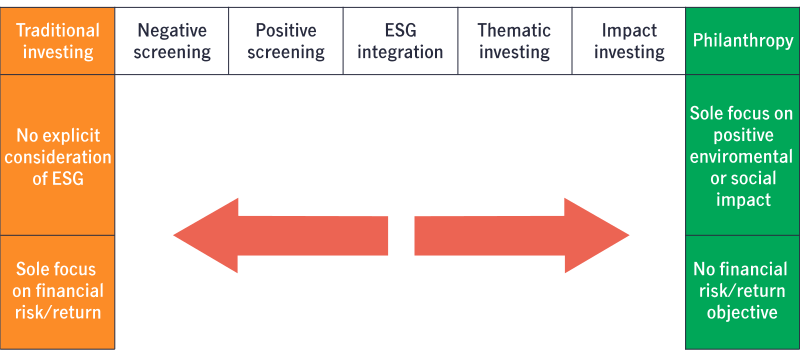
Just a decade ago, ESG investing was largely confined to excluding investments in companies that produce goods and services perceived as harmful to society. While this approach still has a role to play (see “Negative screening” below), today's portfolio managers are increasingly proactive, directly engaging with firms and investing in those making the most significant positive impact. This can go beyond simply integrating ESG factors into investment decision making to actively encouraging companies to improve their sustainability credentials through ongoing stewardship.
While almost all ESG approaches aim to deliver competitive financial returns by managing ESG risks and identifying ESG-related opportunities, how they do so can differ widely. Some of the most common options available include:
A broad spectrum: common methods of ESG investing
Source: Manulife Investment Management, April 2022
Although these options vary in their commitment to ESG principles, they’re not mutually exclusive, and ESG investment strategies may incorporate any number of these approaches.
ESG investing has come a long way over the last few decades, and its evolution is ongoing. While it can be difficult keeping up with the latest trends, it’s important to remember the key aims of ESG investing—it can help align a portfolio with a set of values that are important for the investor.
Fed hikes rates for first time since 2023 as expected
Today’s Federal Open Market Committee (FOMC) decision and press conference went smoothly—a welcome development, in our judgment, after the mixed signals that emerged from the Fed’s July meeting. The rate decision: A 25 basis-point (bps) hike, bringing the federal funds rate from 3.75% to 4.00%.
Beyond AI hype: How Manulife Global Multi Asset Diversified Income Fund (GMADI) evaluates long-term equity opportunities
AI continues to create potential investment opportunities, but we believe not every AI-related company will become a long-term winner. Rather than maximising exposure to the theme, the Manulife Global Fund - Global Multi-Asset Diversified Income Fund takes a selective and valuation-aware approach. In this investment note, we discuss the three characteristics we look for when identifying long-term winners and how these principles are reflected in the Fund's equity sleeve which currently maintains a constructive view on sectors such as communication services, healthcare, consumer staples and energy. This positioning reflects our bottom-up conviction in individual businesses whose long-term fundamentals, cash flow characteristics and valuations are viewed favourably by the investment team.
Asia High Yield has reached new highs; what’s next?
Asia High Yield (HY) bonds, known for providing an attractive source of income, present a very different opportunity set today compared to the pre-pandemic era. As discussed in our investment note from nearly a year ago, the asset class is no longer dominated by Chinese Mainland property developers. Instead, it has become more diversified, with investment opportunities spanning multiple areas, such as financial institutions, gaming operators, infrastructure providers, and selected frontier markets.
Making your money work for you
Inflation: the unseen tax that gradually erodes investors’ purchasing power
How to Set Smart and Effective Financial Goals
In previous episodes, we have explored creating a financial plan and establishing a budget that accounts for your current expenditure. The third step is to build a strategy that will help you accomplish either a short-term or a long-term financial goal. We will guide you on your path by providing financial goal examples and introducing SMART (specific, measurable, attainable, relevant, time-based) objectives that help clearly define what you want to achieve in the years ahead.
5 ways a budget plan can help you manage your finances
We all know approximately how much money we need each month. However, without a clear spending strategy, you could see a shortfall in savings, face a lack of day-to-day cash, or be caught off guard by unexpected costs. That’s why it’s important to have an effective budget plan that will give you control over your finances.

©1999 - 2026 Manulife Investment Management (Hong Kong) Limited


