
4 August 2026
Christopher Walsh, CFA, Senior Portfolio Manager, Multi-Asset Solutions
Paul Kalogirou, Head of Client Portfolio Management, Asia & Global Multi-Asset Solutions


Artificial intelligence (AI) is often positioned as a story of models and applications, but its growth depends heavily on something far more tangible. Real assets such as data centres, power grids, and raw materials form the physical that supports AI development. As structural forces reshape the investment landscape, real assets are emerging as an enabler of the AI buildout.
We believe three major trends are influencing the current investment regime and may affect the outlook for selected real assets:
Among these themes, AI-related infrastructure and energy demand provide an example of where real assets may play a role in the age of intelligence.
The AI stack is sometimes described as a five-layer cake: energy, semiconductors, infrastructure, models, and applications. Real assets intersect with two key layers: energy and infrastructure.
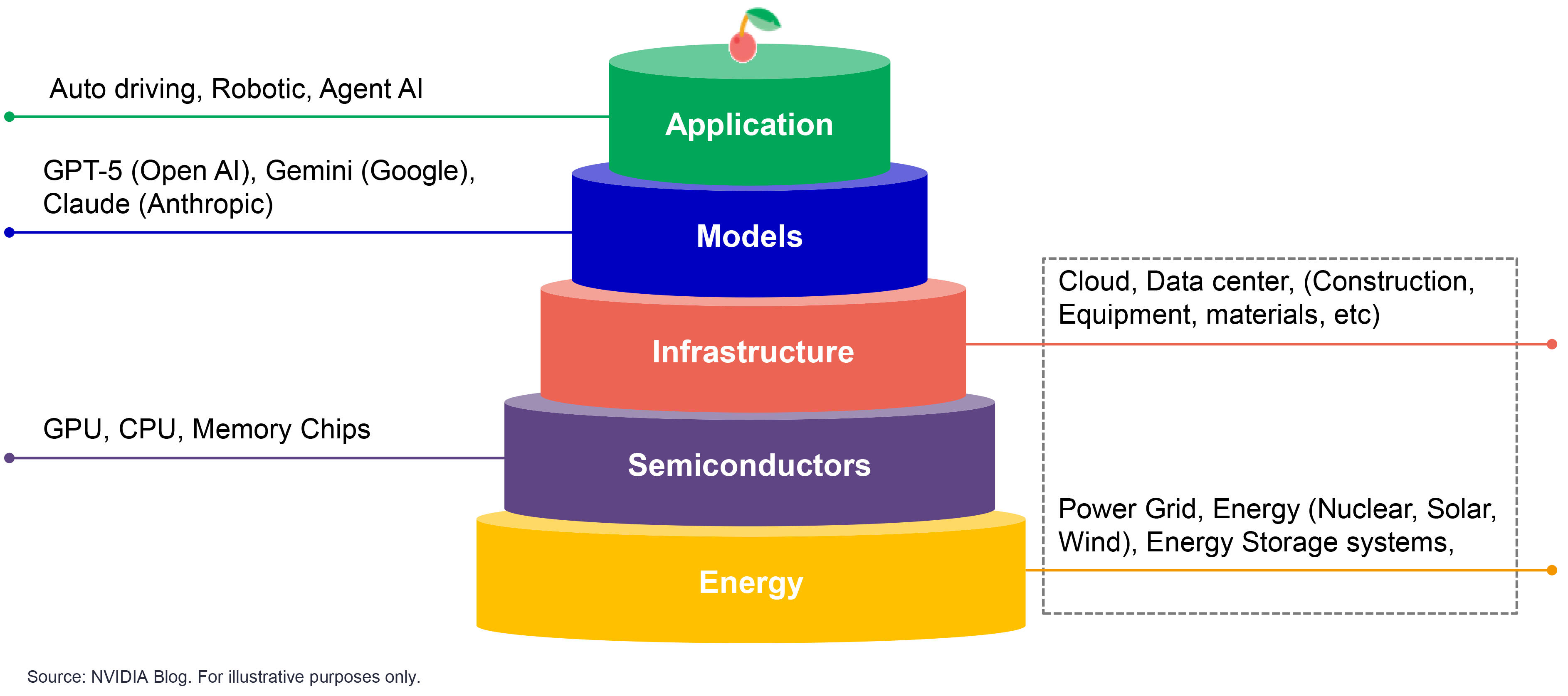
At its core, economic growth can be viewed through the lens of energy use – a principle that helps explain why AI’s expansion is closely linked to the energy required to power it. Meanwhile, the infrastructure layer represents the physical buildout needed to support AI, including data centres, construction, and electrical systems.
Together, these layers form an important foundation supporting the AI ecosystem.
Certain real assets may share traits such as relatively inelastic demand, long lead times for new supply, high barriers to entry, and essential-service characteristics. They can be grouped into four broad categories, which may provide exposure to real-return potential and income generation.
Global Multi Asset Diversified Income Strategy (GMADI) update: A balanced approach to market volatility
Global equity markets have recently experienced sharper movements, particularly in areas linked to artificial intelligence (AI). Earnings announcements from AI hardware, semiconductor and large cloud-computing companies have been key sources of volatility. Concerns about potential interest rate hikes have added to uncertainty. The Global Multi Asset Diversified Income (GMADI) Strategy has not been immune to these market movements. However, its income focus, broad diversification and relatively defensive positioning may help limit the effect of sharp changes in technology and growth-related investments.
Global Equity Diversified Income (GEDI) Fund: Staying selective through market volatility
Global equity markets have recently experienced greater volatility. Much of this has been driven by earnings announcements from AI hardware, semiconductor and large cloud-computing companies. Concerns about potential interest rate hikes have also added to investor uncertainty. After a prolonged period of strong performance in AI-related areas, market expectations have become demanding. Even companies reporting solid results have experienced sharp share-price moves when their outlook has only met, rather than exceeded, investor expectations. Against this backdrop, the GEDI Fund remains focused on its core objective: generating income while maintaining diversified exposure to potential capital growth.
The engine behind AI: Semiconductors are fuelling the next era of technology
Semiconductors belong to one of the most specialised yet globally integrated industry chains. From design, equipment, and materials to manufacturing and commercialisation, the production of a smartphone chip alone spans many countries across continents, creating tremendous opportunities for companies, consumers, and investors. With semiconductors increasingly becoming the backbone of an artificial intelligence (AI) race few are prepared for, understanding this sector is key to unlocking where the next wave of technology competition is heading.
Beyond inflation, we believe several broader themes could provide support for selected real assets:
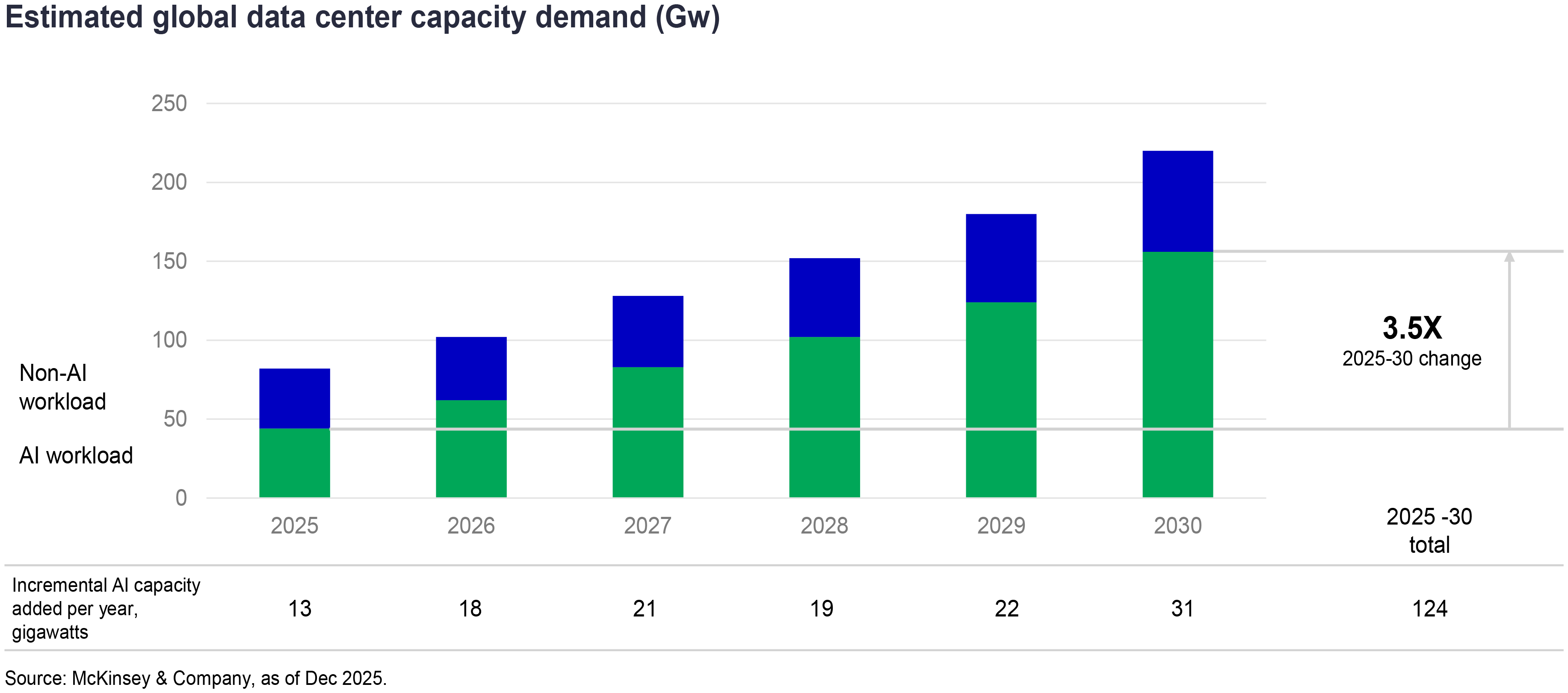
Demand for data and compute capacity is increasing alongside the growth of AI. McKinsey estimates that global demand for data centre capacity could rise at an annual rate of 19% to 22% from 2023 to 2030, reaching annual demand of 171GW to 219GW by 2030.
Companies involved in the infrastructure layer supporting this growth, including engineering and construction firms, may benefit from increased demand, although the timing and scale of opportunities will vary.
In addition, the International Energy Agency (IEA) expects global electricity demand from data centres to more than double by 2030, with AI an important driver of this increase. It also notes that a range of energy sources will likely be needed, with renewables and natural gas expected to play leading roles in key markets. Similarly, data centres could contribute to copper demand over the coming years.
While volatility is likely to accompany the AI infrastructure buildout, we view the theme as a multi-year opportunity that should be assessed alongside valuation, execution, policy, and commodity-cycle risks. Real assets may offer exposure to inflation-sensitive income streams and participation in selected areas of long-term structural growth.
Global Multi Asset Diversified Income Strategy (GMADI) update: A balanced approach to market volatility
Global equity markets have recently experienced sharper movements, particularly in areas linked to artificial intelligence (AI). Earnings announcements from AI hardware, semiconductor and large cloud-computing companies have been key sources of volatility. Concerns about potential interest rate hikes have added to uncertainty. The Global Multi Asset Diversified Income (GMADI) Strategy has not been immune to these market movements. However, its income focus, broad diversification and relatively defensive positioning may help limit the effect of sharp changes in technology and growth-related investments.
Global Equity Diversified Income (GEDI) Fund: Staying selective through market volatility
Global equity markets have recently experienced greater volatility. Much of this has been driven by earnings announcements from AI hardware, semiconductor and large cloud-computing companies. Concerns about potential interest rate hikes have also added to investor uncertainty. After a prolonged period of strong performance in AI-related areas, market expectations have become demanding. Even companies reporting solid results have experienced sharp share-price moves when their outlook has only met, rather than exceeded, investor expectations. Against this backdrop, the GEDI Fund remains focused on its core objective: generating income while maintaining diversified exposure to potential capital growth.
The engine behind AI: Semiconductors are fuelling the next era of technology
Semiconductors belong to one of the most specialised yet globally integrated industry chains. From design, equipment, and materials to manufacturing and commercialisation, the production of a smartphone chip alone spans many countries across continents, creating tremendous opportunities for companies, consumers, and investors. With semiconductors increasingly becoming the backbone of an artificial intelligence (AI) race few are prepared for, understanding this sector is key to unlocking where the next wave of technology competition is heading.

©1999 - 2026 Manulife Investment Management (Hong Kong) Limited


