
29 July 2026
Ryan Davies, CFA Senior Portfolio Manager
Michael P. Evans, CFA Managing Director, Equity Client Portfolio Manager


Semiconductors belong to one of the most specialised yet globally integrated industry chains. From design, equipment, and materials to manufacturing and commercialisation, the production of a smartphone chip alone spans many countries across continents, creating tremendous opportunities for companies, consumers, and investors. With semiconductors increasingly becoming the backbone of an artificial intelligence (AI) race few are prepared for, understanding this sector is key to unlocking where the next wave of technology competition is heading.
Many of us are familiar with how chatbots like ChatGPT and DeepSeek work. Beyond these simple uses, however, few are aware of how AI is already being embedded into everyday life. Some examples of early-stage enterprise AI use cases include:
These examples demonstrate that AI adoption is still in its infancy. The runway for growth looks potentially long, and the opportunities that lie ahead are substantial.
The historical demand drivers of semiconductors have shifted over time: Personal computers (PCs) dominated in the 1990s, followed by handsets in the 2000s. Today, AI is emerging as a pivotal driver of future growth of semiconductors (represented by computing and data storage in the next figure), alongside automotive, consumer, and industrial demand. Valued at nearly US$800 billion in 2024, the semiconductor industry is now projected to reach US$1.6 trillion by 2030.
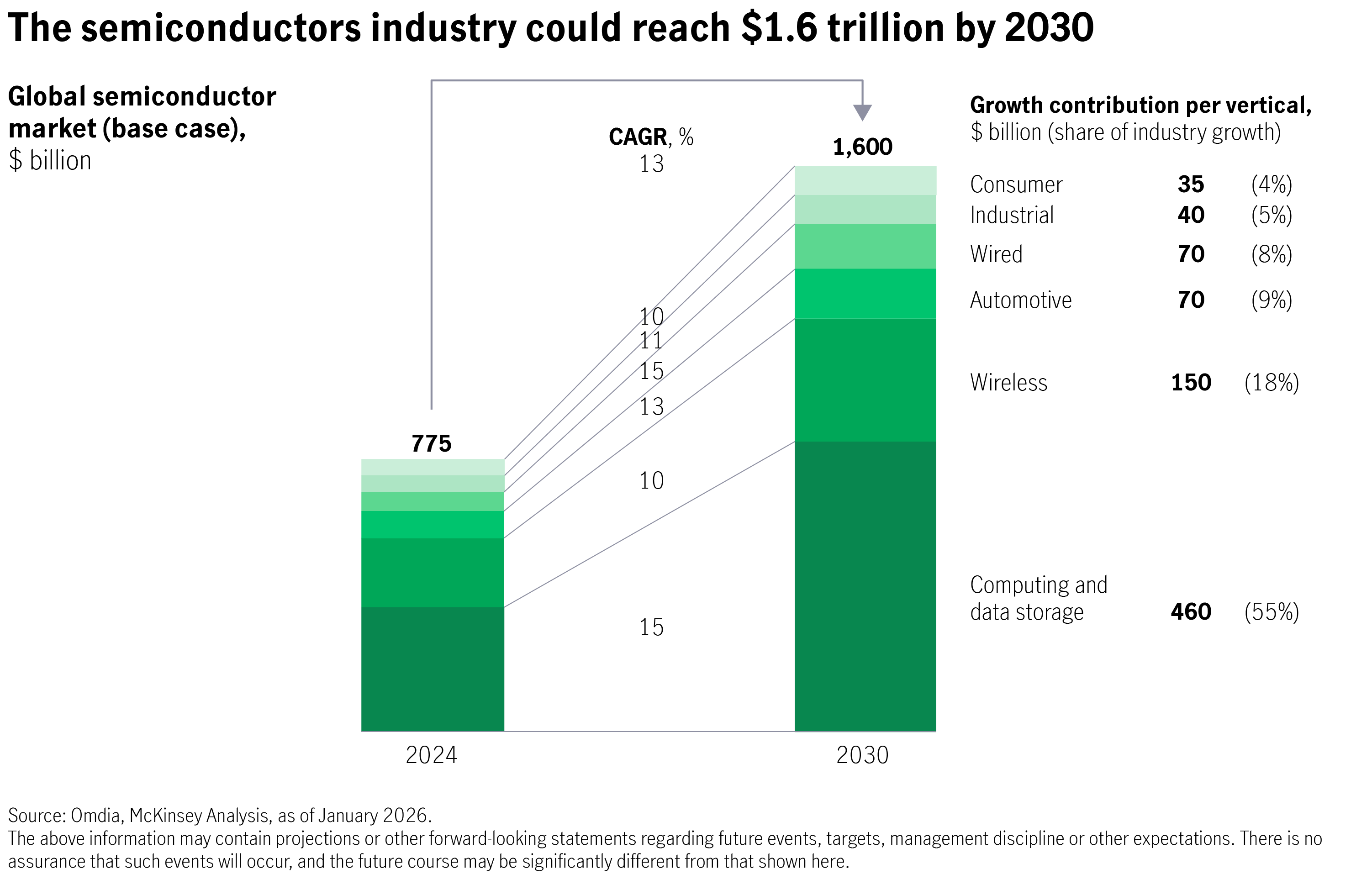
In recent years, we have seen a surge in spending by AI model firms and hyperscalers (i.e., large cloud service providers running data centre networks), which has led to an obvious concern: is there risk of a bubble? We don't believe so; AI infrastructure investment remains foundational rather than late-cycle.
AI spending is concentrated among a handful of hyperscalers, but they are investing on behalf of billions of consumers. Given this combination of concentrated spending and broad-based beneficiaries, we think the current spending cycle is more sustainable than the historically more cyclical semiconductor booms.
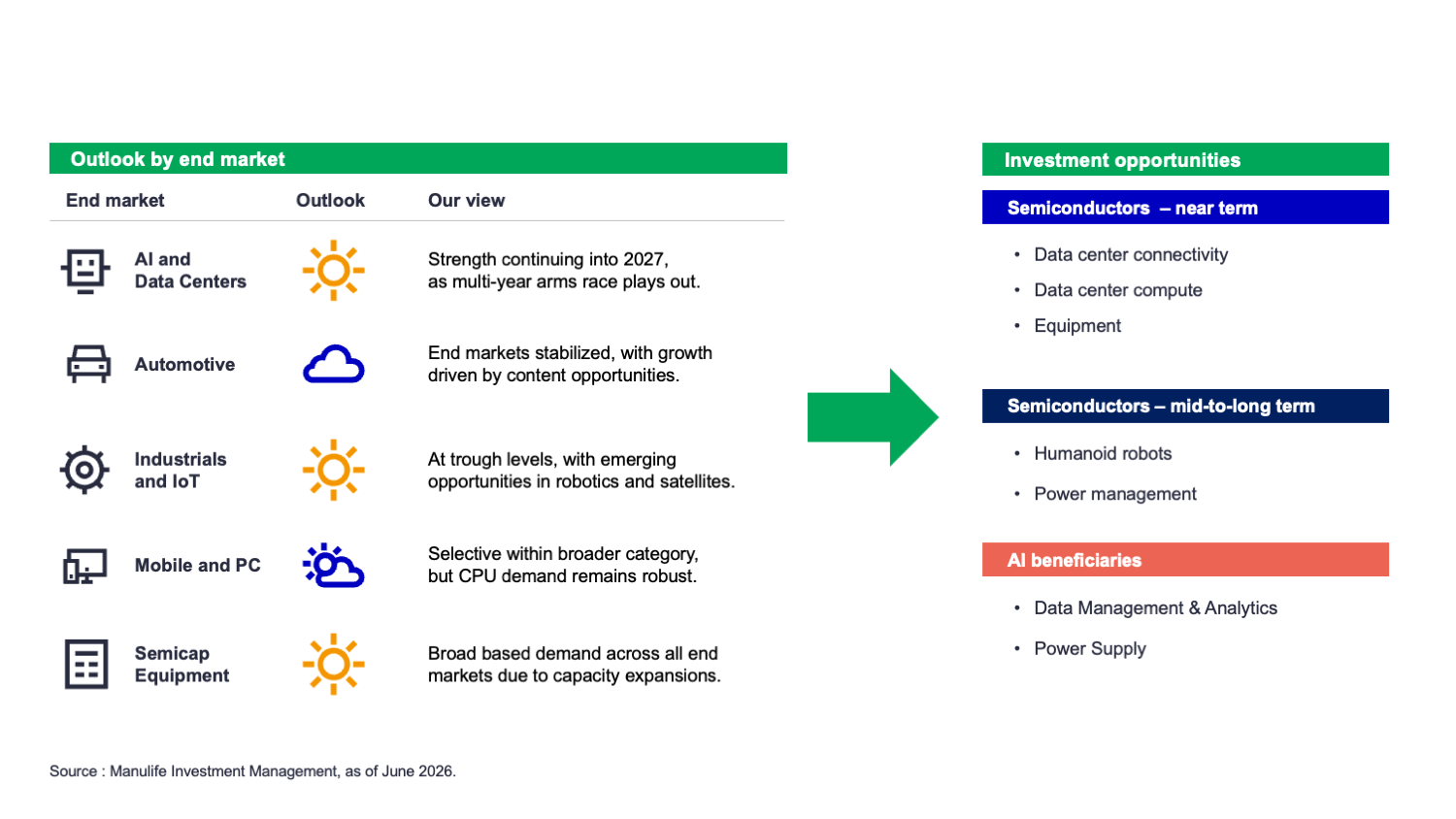
In our view, the sustainability of AI expenditure and the growing range of AI use cases provide tailwinds across the semiconductors and AI value chain. AI and data centres lead the pack, with strength expected to continue into 2027 as a multi-year buildout plays out. Clusters of graphics processing units (GPUs) are driving near-term demand across data centre connectivity, compute, and semiconductor equipment broadly. The outlook looks similarly promising for Industrials and Internet of Things (IoT), while other markets remain more selective.
Looking ahead, humanoid robots are emerging as a longer-term opportunity, with decades of manufacturing and product data now being used to train machines capable of performing tasks autonomously. Meanwhile, power management is fast becoming a critical constraint, as AI's energy appetite increasingly outpaces available grid capacity.
Semiconductors are historically volatile. Although annual corrections of 10-15% are typical, we see these as buying opportunities. Despite the AI narrative, we believe current valuations remain in line with historical averages1, while the earnings of the PHLX Semiconductor Sector Index (SOX) and the index itself have moved closely in tandem over the past 20 years.
The pattern is evident: semiconductor content has been expanding into many areas of daily life and may remain a long-running trend, with AI potentially acting as an accelerator.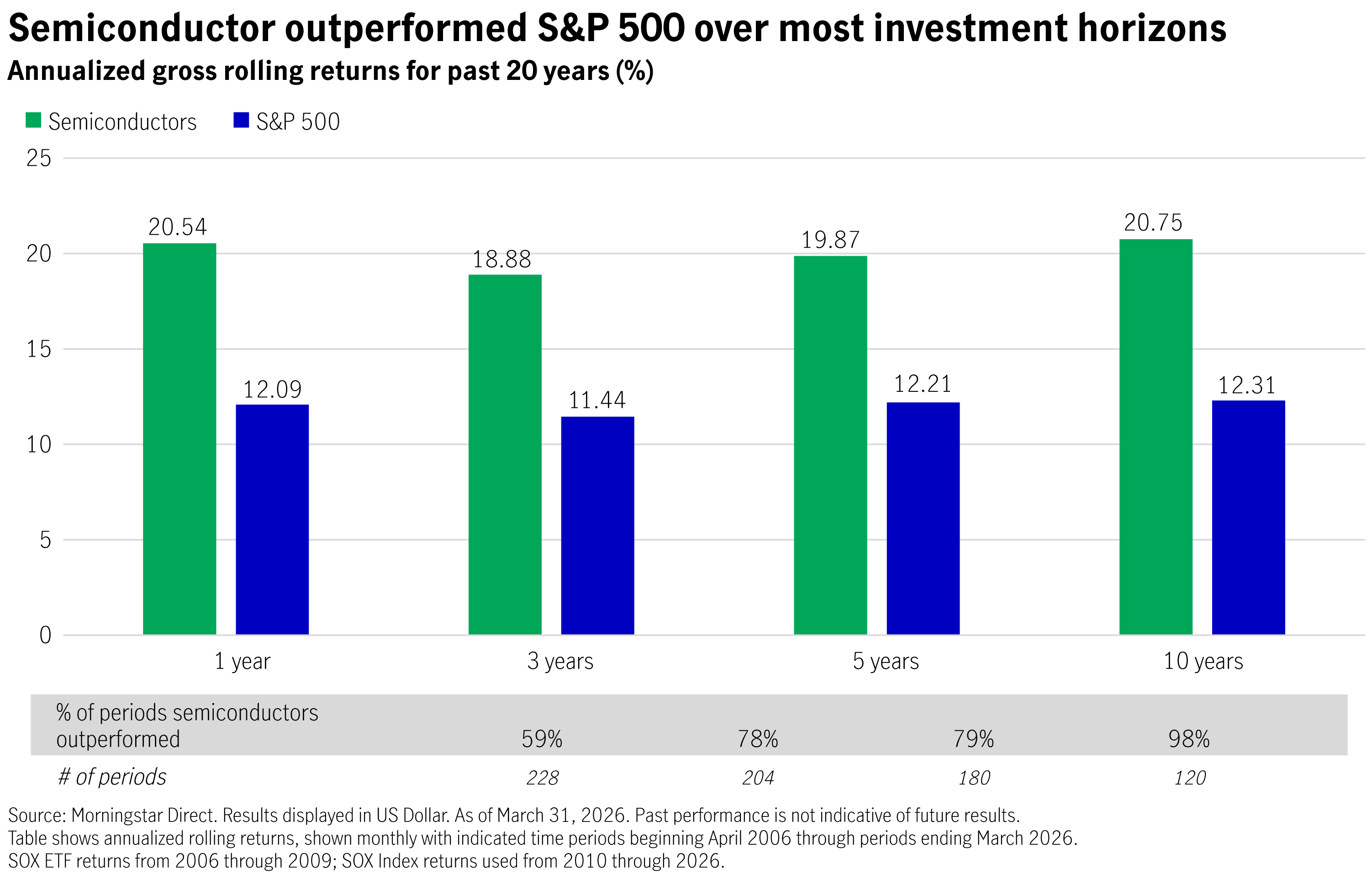
1 Source: Bloomberg, as of 15 June 2026. Semiconductors represented by Philadelphia Semiconductor Index.
Global Multi Asset Diversified Income Strategy (GMADI) update: A balanced approach to market volatility
Global equity markets have recently experienced sharper movements, particularly in areas linked to artificial intelligence (AI). Earnings announcements from AI hardware, semiconductor and large cloud-computing companies have been key sources of volatility. Concerns about potential interest rate hikes have added to uncertainty. The Global Multi Asset Diversified Income (GMADI) Strategy has not been immune to these market movements. However, its income focus, broad diversification and relatively defensive positioning may help limit the effect of sharp changes in technology and growth-related investments.
Global Equity Diversified Income (GEDI) Fund: Staying selective through market volatility
Global equity markets have recently experienced greater volatility. Much of this has been driven by earnings announcements from AI hardware, semiconductor and large cloud-computing companies. Concerns about potential interest rate hikes have also added to investor uncertainty. After a prolonged period of strong performance in AI-related areas, market expectations have become demanding. Even companies reporting solid results have experienced sharp share-price moves when their outlook has only met, rather than exceeded, investor expectations. Against this backdrop, the GEDI Fund remains focused on its core objective: generating income while maintaining diversified exposure to potential capital growth.
Real assets and the infrastructure behind AI
Artificial intelligence (AI) is often positioned as a story of models and applications, but its growth depends heavily on something far more tangible. Real assets such as data centres, power grids, and raw materials form the physical that supports AI development. As structural forces reshape the investment landscape, real assets are emerging as an enabler of the AI buildout.
Global Multi Asset Diversified Income Strategy (GMADI) update: A balanced approach to market volatility
Global equity markets have recently experienced sharper movements, particularly in areas linked to artificial intelligence (AI). Earnings announcements from AI hardware, semiconductor and large cloud-computing companies have been key sources of volatility. Concerns about potential interest rate hikes have added to uncertainty. The Global Multi Asset Diversified Income (GMADI) Strategy has not been immune to these market movements. However, its income focus, broad diversification and relatively defensive positioning may help limit the effect of sharp changes in technology and growth-related investments.
Global Equity Diversified Income (GEDI) Fund: Staying selective through market volatility
Global equity markets have recently experienced greater volatility. Much of this has been driven by earnings announcements from AI hardware, semiconductor and large cloud-computing companies. Concerns about potential interest rate hikes have also added to investor uncertainty. After a prolonged period of strong performance in AI-related areas, market expectations have become demanding. Even companies reporting solid results have experienced sharp share-price moves when their outlook has only met, rather than exceeded, investor expectations. Against this backdrop, the GEDI Fund remains focused on its core objective: generating income while maintaining diversified exposure to potential capital growth.
Real assets and the infrastructure behind AI
Artificial intelligence (AI) is often positioned as a story of models and applications, but its growth depends heavily on something far more tangible. Real assets such as data centres, power grids, and raw materials form the physical that supports AI development. As structural forces reshape the investment landscape, real assets are emerging as an enabler of the AI buildout.

©1999 - 2026 Manulife Investment Management (Hong Kong) Limited


