
6 December 2023
Howard C. Greene, Senior Portfolio Manager, Co-Head of U.S. Core and Core-Plus Fixed Income
Jeffrey N. Given, Senior Portfolio Manager, Co-Head of U.S. Core and Core-Plus Fixed Income
Connor Minnaar, Portfolio Manager, Core and Core-Plus Fixed Income


Bond market volatility remains elevated as rates have shifted rapidly, with investors digesting an inflow of mixed economic data to ascertain a path forward for economic growth and central bank policy. No matter whether a soft landing or a recession is ahead, Howard Greene and Jeffrey Given, Senior Portfolio Manager and Co-Head of US Core and Core-Plus Fixed Income, as well as Connor Minnaar, Portfolio Manager of Core and Core-Plus Fixed Income, believe that intermediate fixed income can present a compelling alternative to both equities and short duration fixed income.
After the bond market experienced one of its worst years ever in 2022, investors were likely looking for some reprieve from further losses in what's supposed to be the ballast within their portfolios. Unfortunately, fixed income has continued to come under pressure, with 2023 having the potential to become the third calendar year with a negative return for the Bloomberg U.S. Aggregate Bond Index.
Whether or not bonds will continue to see losses is anyone’s guess, with mixed economic data continuing to paint an unclear picture of the path forward for interest rates and the economy. This murky outlook has resulted in heightened volatility for fixed income, but we maintain our conviction that intermediate fixed income is attractively positioned for the market ahead.
The U.S. Federal Reserve (Fed) has swiftly and severely moved away from its long-standing near-zero interest-rate policy, and the federal funds rate is now at its highest level since 2001. Rising rates, and the blistering pace of their increase, have weighed on all corners of the fixed-income market, acting as the main driver of the recent bond market drawdown due to the inverse relationship between yields and bond prices.
Although being a bond investor hasn’t been a pleasant experience for the past few years, this backdrop has created a few silver linings for fixed-income investors moving ahead. First, investors can now lock in bond yields that are at their highest level in a decade or more. In addition to these yields, prices for many parts of the fixed-income market are attractive, trading well below their historical averages (Chart 1).
Chart 1: Bond prices look attractive on a historical basis
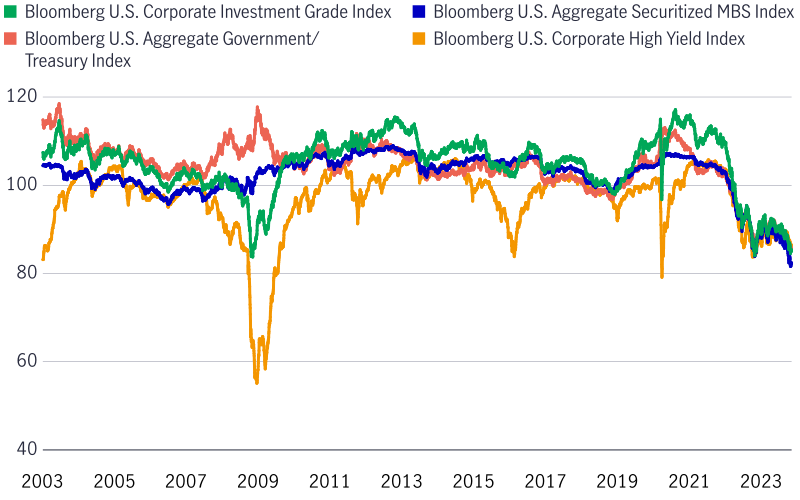
Source: FactSet, as of September 30, 2023. The Bloomberg U.S. Corporate Investment Grade Index tracks the performance of the investment-grade, fixed-rate, taxable corporate bond market. The Bloomberg U.S. Aggregate Securitized Mortgage-Backed Securities (MBS) Index tracks the performance of investment-grade U.S. securitized MBS. The Bloomberg U.S. Aggregate Government/Treasury Index tracks the performance of public obligations of the U.S. Treasury comprising U.S. Treasury bonds and notes across maturities ranging from one to thirty years. The Bloomberg U.S. Corporate High Yield (HY) Bond Index tracks the performance of the U.S. dollar-denominated, HY, fixed-rate corporate bond market. It is not possible to invest directly in an index. Past performance does not guarantee future results.
In sum, this means that fixed-income investors, including those in core and core-plus strategies, could see the rare opportunity to benefit from both income and price appreciation if the economic outlook deteriorates and yields continue to fall.
The sharp increase in rates also suggests that after years of rock-bottom yields, bonds now offer a compelling alternative to equities. This is particularly true if the fears of a recession come to fruition, but even if the economic outlook remains relatively stable and rates stay higher for longer, we believe that bond yields will remain rangebound in the mid- to high single digits and continue to offer an attractive income stream for investors. As we’ve discussed before, starting yields are a significant driver of forward total returns, which means that current yields present a compelling opportunity, one that investors would be remiss to pass up.
Chart 2: The end of Fed tightening cycles tends to favor intermediate duration bonds over stocks
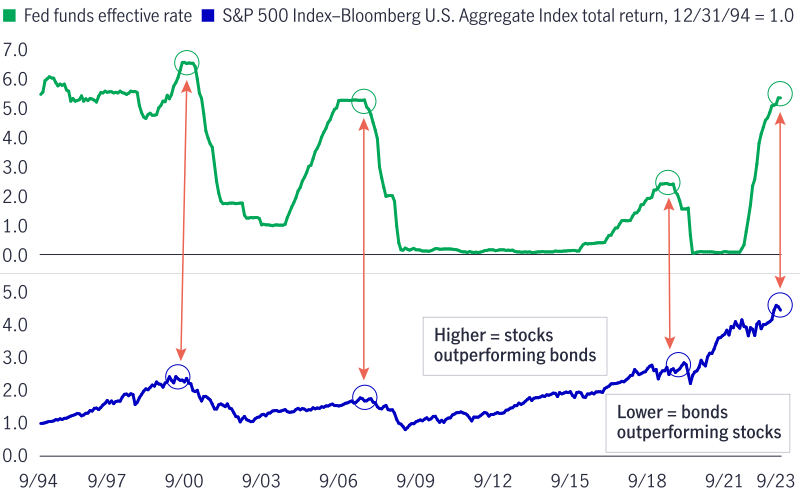
Source: eVestment, Federal Reserve Bank of St. Louis, John Hancock Investment Management. Data is as of September 30, 2023. The S&P 500 Index tracks the performance of 500 of the largest companies in the United States. The Bloomberg U.S. Aggregate Bond Index tracks the performance of U.S. investment-grade bonds in government, asset-backed, and corporate debt markets. It is not possible to invest directly in an index. Past performance does not guarantee future results.
While a portfolio should be well diversified and constructed in line with an investor’s risk tolerance and risk capacity, this policy backdrop could favor tactically adding to a fixed-income allocation in the months ahead.
Within fixed income, we also maintain our conviction that intermediate duration presents a better opportunity than shorter duration fixed income, a view that we’ve held for quite some time. With yields often seeing rapid shifts this year, being able to lock in yield for years to come could be a significant benefit, avoiding the reinvestment risk that comes along with short duration and money market instruments.
Chart 3: Treasury yields have been volatile this year
10-year U.S. Treasury yield (%)
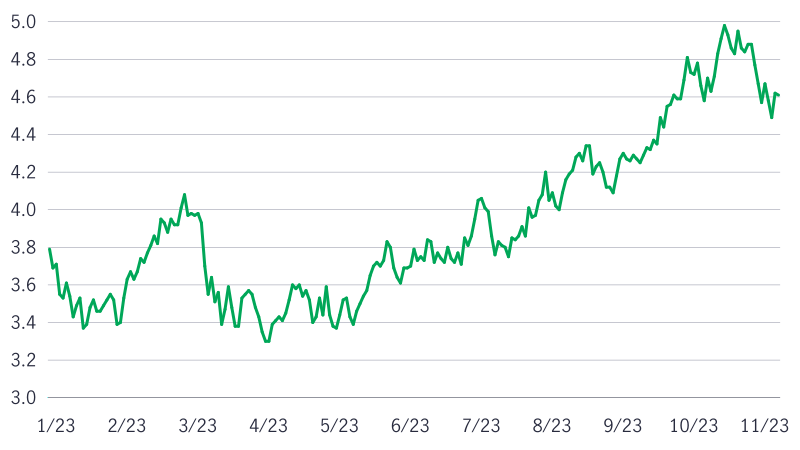
Source: U.S. Department of the Treasury, as of November 13, 2023.
History also tells us that the fixed-income market often moves before the Fed does, with investors anticipating a pivot in monetary policy before it happens. We also know that while monetary policy tends to happen in a slow and steady fashion, central banks tend to act quickly once they do begin cutting rates.
While we can’t be sure where yields will top out, we believe that investors shouldn’t downplay the risk of sitting in cash as they run the risk of missing out on some of the price appreciation that has historically occurred as yields fall in advance of or just after a shift in monetary policy, a phenomenon that provides greater benefit to intermediate and longer duration strategies.
With fixed-income markets seeing increased volatility and the economic outlook still hazy, we believe that active management can add significant value, giving portfolio managers the flexibility to adapt to shifting markets.
There are many signposts that a recession may be around the corner, including an inverted yield curve and negative leading economic indicators. While some pockets of economic data such as the labor market remain surprisingly strong, we believe it’s now prudent to tilt portfolios toward more defensive areas of the fixed-income market.
One area of opportunity that we’re seeing includes agency mortgage-backed securities (MBS), high-quality securities backed by the full faith and credit of the U.S. government; however, agency MBS do still entail a degree of credit risk. Like other credit-sensitive sectors, this area of the market has seen widening spreads over much of the past year, which we believe has created a relative value opportunity. Additionally, allocating more of the portfolio toward agency MBS can help shore up the quality of the portfolio without sacrificing yield or liquidity.
Given the potential for economic weakness, we also have a favorable view of U.S. Treasuries. In the past few months, various technical drivers have sent yields higher, including Fitch’s downgrade of U.S. debt, the ongoing risk of a government shutdown amid a highly polarized political environment, fewer foreign buyers of U.S. debt, and the increasing size of auctions by the U.S. Department of the Treasury. While these factors might lead to continued volatility in the Treasury market in the short term, we don’t believe this changes the fundamentals for this area of the market.
We believe that corporate bonds are an area that could see underperformance if the economic outlook continues to weaken and spreads widen further. However, we believe that pockets of opportunity within corporates exist due to wide divergence in valuations between sectors. Financial institutions and super-regional banks are one area where we’re seeing value, as capital requirements and tightening lending standards should provide support to these bonds moving ahead. Utilities is another sector of interest, as these bonds are trading cheap relative to their history.
We continue to believe that the best offense is a good defense. Although lower-quality and cyclical fixed-income investments have held up stronger than we would have expected, we remain patient and continue to prioritize quality and liquidity. With higher yields than we’ve seen in years, we believe that intermediate-term bonds in the core and core-plus space are well positioned for whatever lies ahead.
2026 Mid-year outlook: Asian Fixed Income
In this Mid-Year Outlook, the Asian Fixed Income team explains this important change in monetary policy expectations, and why the asset class is well positioned to capitalise on it.
2026 Mid-Year Outlook Series: Asia Equities ex-Japan
Asia equities ex-Japan continued the significant momentum from 2025 with strong performance throughout the first half of the year. Amid numerous catalysts, June Chua, Head of Asia Equities outlines in this Mid-Year Outlook why she is constructive on the asset class for the remainder of 2026. Positive drivers include: potential geopolitical resolution in the Middle East and lower energy costs, supportive earnings and valuations, and differentiated growth drivers across the region.
2026 Mid-year outlook: Greater China Equities
Greater China equity markets showed divergent trends in the first half of 2026, with China A-shares and the Taiwan Taiex index registering strong gains driven by resilient technology exports amid global demand for artificial intelligence (AI). Meanwhile, the MSCI China market pulled back, weighed by commerce subsidies amid fierce competition in food delivery and rising AI capital expenditure, which we believe have already been priced in. In this mid-year Outlook, we highlight five positive drivers for China and Hong Kong equities in the second half of the year. Furthermore, the team explains why it believes the Taiwan region’s technology sector should continue to enjoy positive momentum.
2026 Mid-year outlook: Asian Fixed Income
In this Mid-Year Outlook, the Asian Fixed Income team explains this important change in monetary policy expectations, and why the asset class is well positioned to capitalise on it.
2026 Mid-Year Outlook Series: Asia Equities ex-Japan
Asia equities ex-Japan continued the significant momentum from 2025 with strong performance throughout the first half of the year. Amid numerous catalysts, June Chua, Head of Asia Equities outlines in this Mid-Year Outlook why she is constructive on the asset class for the remainder of 2026. Positive drivers include: potential geopolitical resolution in the Middle East and lower energy costs, supportive earnings and valuations, and differentiated growth drivers across the region.
2026 Mid-year outlook: Greater China Equities
Greater China equity markets showed divergent trends in the first half of 2026, with China A-shares and the Taiwan Taiex index registering strong gains driven by resilient technology exports amid global demand for artificial intelligence (AI). Meanwhile, the MSCI China market pulled back, weighed by commerce subsidies amid fierce competition in food delivery and rising AI capital expenditure, which we believe have already been priced in. In this mid-year Outlook, we highlight five positive drivers for China and Hong Kong equities in the second half of the year. Furthermore, the team explains why it believes the Taiwan region’s technology sector should continue to enjoy positive momentum.

©1999 - 2026 Manulife Investment Management (Hong Kong) Limited


