Back


Latest asset allocation views for Asia Q1 2026

10 March 2026

Summary:

  • Three key global themes for the first quarter: Liquidity and stimulus set the stage for 2026; AI remains a structural growth driver; Accelerating growth may favour diversification
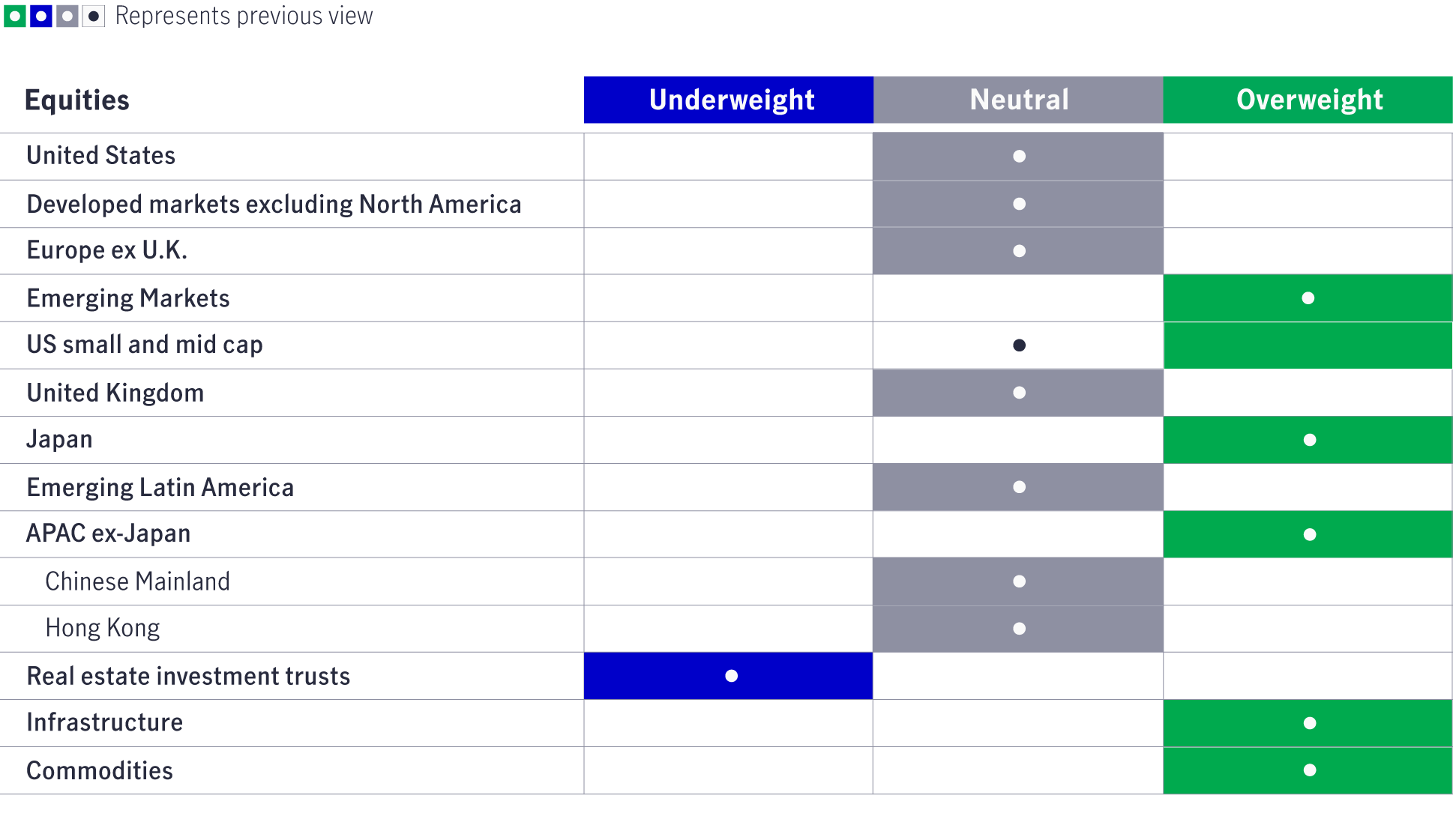
  • We’ve shifted to neutral on developed international markets ex-North America. Improving US data suggests a less favourable growth differential versus the prior quarter.
  • Asia’s manufacturing recovery and the AI boom driving strength in Taiwan and South Korea, led us to upgrade Asia-Pacific ex-Japan equities to overweight.
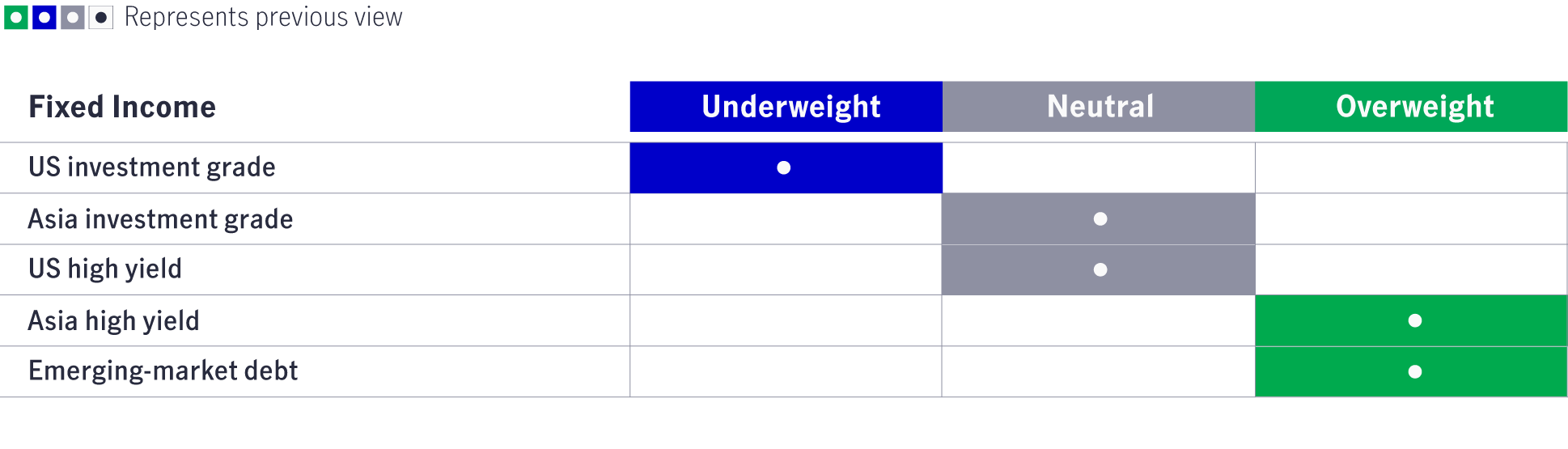
  • Within Asia, we favour high yield over investment-grade credits given attractive relative valuations, wider spreads, and strong local demand, especially as rate cuts improve refinancing conditions and credit profiles.

Positioning for what’s next: late-cycle dynamics, AI opportunities and multipolar growth.


  • We expect 2026 to improve steadily as the year progresses. Despite near-term uncertainty, stronger liquidity, fiscal stimulus, the lagged impact of easier monetary policy, and greater familiarity with the current U.S. administration should support economic growth and global risk assets.

  • Central banks are largely nearing the end of their policy cycles. The US Federal Reserve (Fed) may deliver a few measured cuts, while Canada and Europe remain on extended hold. The United Kingdom faces the challenge of balancing high inflation with weak growth, which will likely keep it from easing policy. Japan is likely to continue very gradual rate hikes as it normalises policy.
  • US equity markets remain supported by AI-driven momentum, led by large-cap tech. Heavy investment in data centers, semiconductors, and cloud infrastructure in both China and the United States fuels optimism, even as valuations stretch historical norms.
  • AI enablers such as infrastructure and hardware have been clear winners, while end-user adoption in software, healthcare, and other sectors are yet to deliver meaningful success. Elevated debt among AI-focused firms remains a concern.
  • AI remains a structural growth theme, and capital investment should broaden economic impact. Current dynamics favour exposure to proven AI beneficiaries, with balance from quality cyclicals and non-US opportunities to hedge valuation risk.
  • Global growth should pick up in 2026 driven by rate cuts and persistent fiscal support. Additionally, moderating inflation and supportive liquidity should favour risk assets. Policy divergence and equity concentration make regional and asset class diversification crucial.
  • International markets are gaining traction as Europe’s recovery strengthens and global diversification themes re-emerge. Rising flows into non-US regions reflect a shift toward broader exposure in a multipolar world, supported by improving growth, attractive valuations, and Europe’s defense spending.
  • Emerging markets (EM) have been a bright spot, with selective opportunities ahead. South Korea and Taiwan stand out on tech and policy support, while early signs point to a more constructive tactical view on China. US dollar weakness and global growth recovery are tailwinds, but geopolitical risks and earnings uncertainty call for caution.

Copper stands out amid supply constraints3

A supply-demand imbalance supports the metal’s outlook, even amid growth risks.

Commodities can help diversify and protect against inflation. Despite slower global growth, supply constraints and long-term trends, like electrification and renewable energy, keep the outlook positive. We favour base metals—especially copper and aluminum—alongside gold, as they're essential for the energy transition and infrastructure development.

Global copper supply remains tight due to mining disruptions and few new projects. In China—the world’s largest smelting hub—record low processing fees highlight a shortage of copper concentrate and intense competition among smelters. Recent policies aimed at curbing excess capacity could further restrict supply growth.

Copper demand is supported by China’s stimulus and focus on high-tech and green manufacturing, which will lift consumption, as well as growing global electrification and renewable energy projects. Emerging technologies like data centers and AI aid support. With demand expected to outpace supply into 2026, copper remains an attractive long-term opportunity.

Copper benefits from near-term tailwinds, including a weaker US dollar and targeted infrastructure and energy transition spending that's driving demand despite slowing global growth. However, risks remain: a sharper economic deceleration could hurt industrial activity, and renewed tariff uncertainty or trade tensions may disrupt supply and demand dynamics.

Copper treatment charges at record lows4

Driving upward pressure on copper prices

Copper treatment charges at record lows


1 Source: Manulife Investment Management, 31 December, 2025. Projections or other forward-looking statements regarding future events, targets, management discipline or other expectations are only current as of the date indicated. There is no assurance that such events will occur, and if they were to occur, the result may be significantly different than that shown here. No forecasts are guaranteed. These views are updated on a quarterly basis. This commentary is provided for informational purposes only and is not an endorsement of any security, mutual fund, sector, or index. Diversification does not guarantee a profit or eliminate the risk of a loss.

2 Source: Multi-Asset Solutions Team (MAST), as of 31 December 2025. Projections or other forward-looking statements regarding future events, targets, management discipline or other expectations are only current as of the date indicated. There is no assurance that such events will occur, and if they were to occur, the result may be significantly different than that shown here. Information about asset allocation view is as of issue date and may vary. Active asset allocation views will be updated on a quarterly basis.

3 Source: Multi-Asset Solutions Team (MAST), as of 31 December 2025. Projections or other forward-looking statements regarding future events, targets, management discipline or other expectations are only current as of the date indicated. There is no assurance that such events will occur, and if they were to occur, the result may be significantly different than that shown here.

Source: Bloomberg, Macrobond, Manulife Investment Management, as of 26 November 2025. TC refers to treatment charge, a fee paid by miners to smelters for processing copper concentrate into refined copper. 25% indicates the copper content in the concentrate. CIF refers to Cost, Insurance, and Freight, specifying that the seller covers these costs to deliver the goods to a port.