
29 July 2026
Gun Woo, Senior Director, Portfolio Manager
June Chua, Head of Asia Equities

When electricity first arrived, the world built the necessary infrastructure – power plants, transmission lines – before the real transformation could take hold.
A similar process is happening with artificial intelligence (AI). Today's massive investment in chips, data centres, and power grids is laying the foundation for a potential expansion in AI application that could take years to develop. In our view, the discussion is increasingly shifting from whether AI adoption will continue to how the enabling infrastructure is being built. Asia appears to be playing an important role in that development.
Intelligence is defined as the ability to sense, analyse, and react to information. Within the context of AI, machine learning does exactly this, using graphics processing units (GPUs) to process information and memory to store and transfer it. Then came generative AI, widely associated with the launch of ChatGPT in 2022, when machines started providing intelligent responses to questions. By 2026, agentic AI had arrived: machines could now carry out tasks, such as sending emails, making reservations, and writing software code.
Each stage of this evolution has demanded a bigger "computer", requiring more GPUs and more memory. And as AI advanced from talking to working, demand accelerated with it. The advent of agentic AI in 2026 marked a notable increase in token consumption, a measure of how much AI is being used.
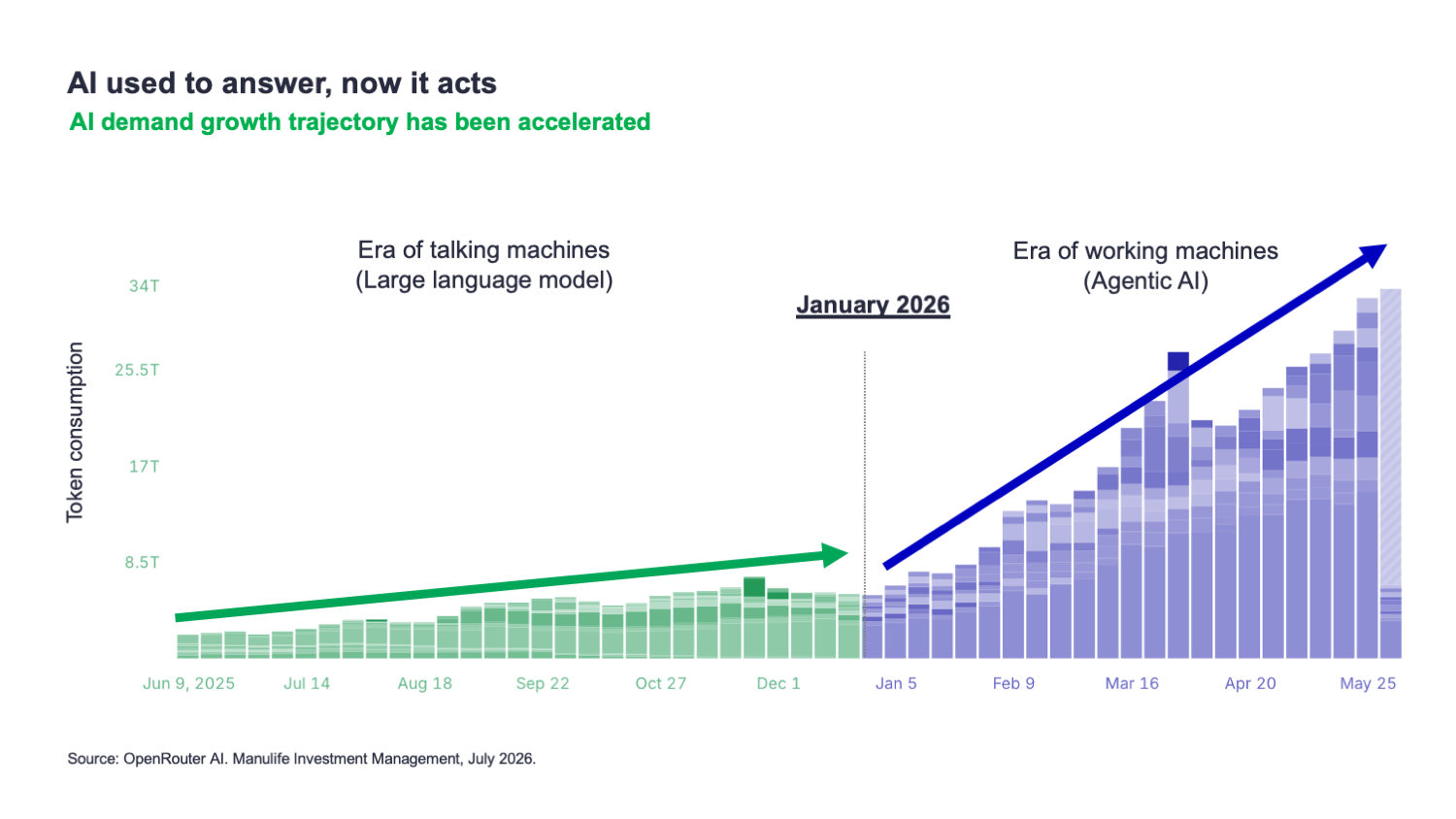
Meeting the rapid rise in demand for AI requires more than just clever algorithms – it requires physically building the infrastructure to support it at a significant scale.
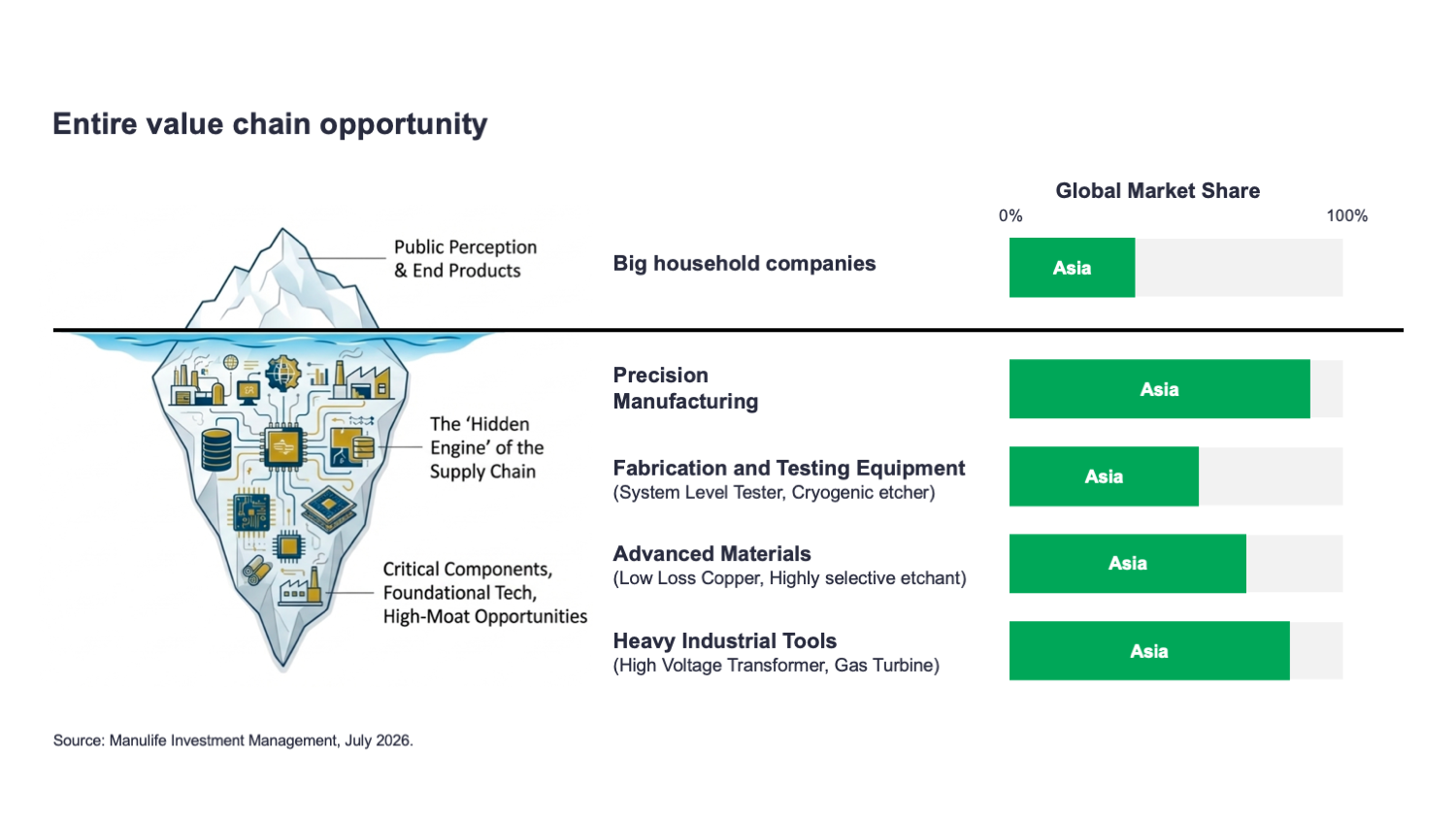
When we talk about AI companies, big household names are often the first to come to mind. However, beyond the surface lies a broad network of less visible manufacturers, equipment makers, and materials suppliers. From precision manufacturing to fabrication and testing equipment, advanced materials, and heavy industrial tools, only a handful of companies in the world possess the capability to deliver. Most of these companies are based in Asia.
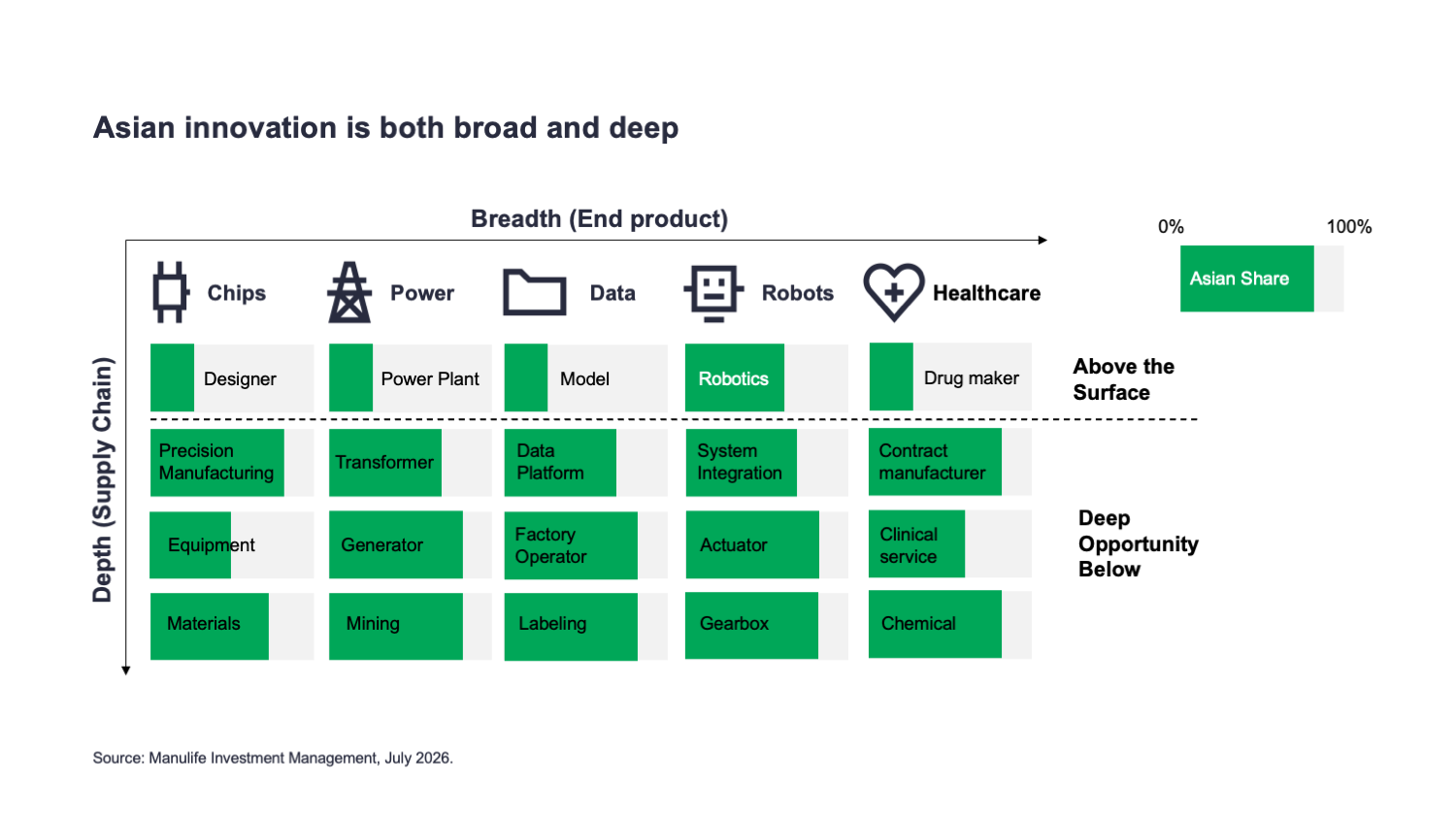
Asia's footprint spans a wide range of AI verticals, including chips, power, data, robotics, and healthcare.
Across each of these, the same engine pattern repeats itself. For instance, in robotics, a chain of system integrators, actuator makers, and gearbox manufacturers operate mostly unnoticed beneath it, we believe some of them appear to be in competitive positions from fundamentals and valuation perspectives.
Asia’s market share looks to increase further down the AI value chain. These areas may present a differentiated opportunity set.
Innovation has long depended on proximity to manufacturing, and Asia has long been considered a major manufacturing hub, supported by established production ecosystems and capacity in several industries.
Source: WIPO Global Innovation Index 2025; UNESCO; TrendForce; SNE Research; Manulife Investment Management estimates, as of July 2026.
Solid manufacturing know-how and skill enable better quality products at competitive prices, which in turn may drive more consumer demand. Greater demand may bring greater volume through the region's factories, feeding a virtuous cycle that may compound over time.
With Asia’s manufacturing scale and supply chain strength, we believe the region appears well positioned to participate in the next phase of industrial and technology transformation.
From the chips that power AI to the applications that may define its future, Asia is helping build many of the technologies that the world runs on.
Fed hikes rates for first time since 2023 as expected
Today’s Federal Open Market Committee (FOMC) decision and press conference went smoothly—a welcome development, in our judgment, after the mixed signals that emerged from the Fed’s July meeting. The rate decision: A 25 basis-point (bps) hike, bringing the federal funds rate from 3.75% to 4.00%.
Beyond AI hype: How Manulife Global Multi Asset Diversified Income Fund (GMADI) evaluates long-term equity opportunities
AI continues to create potential investment opportunities, but we believe not every AI-related company will become a long-term winner. Rather than maximising exposure to the theme, the Manulife Global Fund - Global Multi-Asset Diversified Income Fund takes a selective and valuation-aware approach. In this investment note, we discuss the three characteristics we look for when identifying long-term winners and how these principles are reflected in the Fund's equity sleeve which currently maintains a constructive view on sectors such as communication services, healthcare, consumer staples and energy. This positioning reflects our bottom-up conviction in individual businesses whose long-term fundamentals, cash flow characteristics and valuations are viewed favourably by the investment team.
Asia High Yield has reached new highs; what’s next?
Asia High Yield (HY) bonds, known for providing an attractive source of income, present a very different opportunity set today compared to the pre-pandemic era. As discussed in our investment note from nearly a year ago, the asset class is no longer dominated by Chinese Mainland property developers. Instead, it has become more diversified, with investment opportunities spanning multiple areas, such as financial institutions, gaming operators, infrastructure providers, and selected frontier markets.
Fed hikes rates for first time since 2023 as expected
Today’s Federal Open Market Committee (FOMC) decision and press conference went smoothly—a welcome development, in our judgment, after the mixed signals that emerged from the Fed’s July meeting. The rate decision: A 25 basis-point (bps) hike, bringing the federal funds rate from 3.75% to 4.00%.
Beyond AI hype: How Manulife Global Multi Asset Diversified Income Fund (GMADI) evaluates long-term equity opportunities
AI continues to create potential investment opportunities, but we believe not every AI-related company will become a long-term winner. Rather than maximising exposure to the theme, the Manulife Global Fund - Global Multi-Asset Diversified Income Fund takes a selective and valuation-aware approach. In this investment note, we discuss the three characteristics we look for when identifying long-term winners and how these principles are reflected in the Fund's equity sleeve which currently maintains a constructive view on sectors such as communication services, healthcare, consumer staples and energy. This positioning reflects our bottom-up conviction in individual businesses whose long-term fundamentals, cash flow characteristics and valuations are viewed favourably by the investment team.
Asia High Yield has reached new highs; what’s next?
Asia High Yield (HY) bonds, known for providing an attractive source of income, present a very different opportunity set today compared to the pre-pandemic era. As discussed in our investment note from nearly a year ago, the asset class is no longer dominated by Chinese Mainland property developers. Instead, it has become more diversified, with investment opportunities spanning multiple areas, such as financial institutions, gaming operators, infrastructure providers, and selected frontier markets.

©1999 - 2026 Manulife Investment Management (Hong Kong) Limited


