
19 June, 2020
The COVID-19 outbreak, growing resistance to globalisation, and rising US-China trade tensions—once again—are a perfect recipe for a challenging macroeconomic backdrop. But the news isn’t all bad—according to our Senior Macro Strategist Sue Trinh, the tough operating environment could reveal important growth opportunities for Southeast Asian economies.
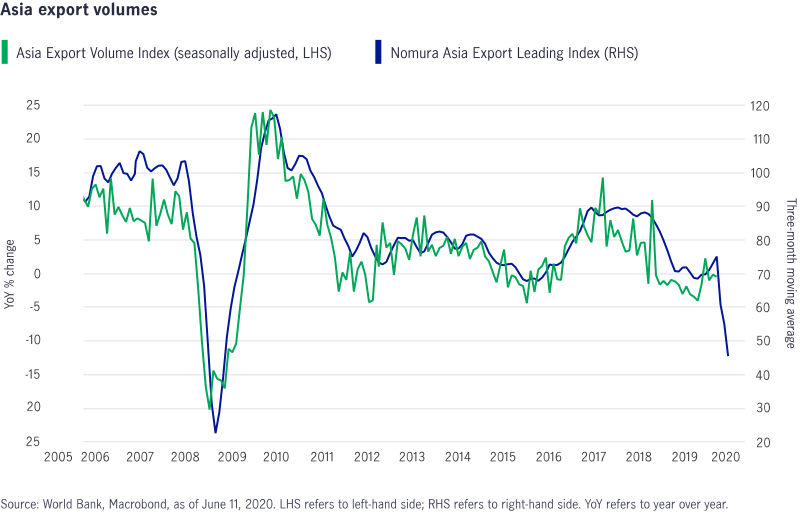
Global trade volumes topped out in 2018 amid slowing global growth and ongoing trade tensions between the United States and China. In 2020, the global pandemic has been another headwind for global trade. Nomura’s leading index of Asian exports, which aggregates the region’s exports (excluding Japan) of eight forward-looking components, and typically has a three-month lead, is signaling that aggregate export growth in the region could shrink between 10% to 20% (relative to last year) in the coming months.¹ Further downside risk to global trade comes from the worsening relationship between the United States and China and the potential for a reescalation in trade tensions.
Understandably, this backdrop makes for a difficult environment for Southeast Asian economies—specifically, members of the Association of Southeast Asian Nations (ASEAN), a group of highly trade-dependent economies. That said, how the region weathered challenges in the past two years has given us some confidence in its ability to navigate the current environment.
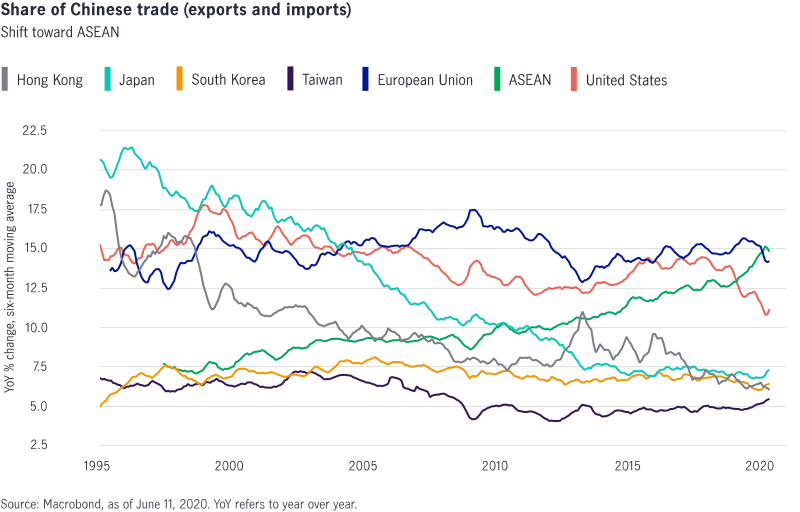
The ASEAN region has been a big beneficiary of ongoing trade tensions, the global pandemic, and China’s relatively early emergence from the COVID-19 outbreak. The region’s share of global trade has gone from strength to strength since 2000, with trade in electronics and integrated circuits being a major driver. When the U.S.-China trade war started to escalate in early 2018, there were fears that slower global trade growth would negatively impact the trade-dependent region. But as events unfolded, it became clear that China looked increasingly to ASEAN to offset the impact of the trade war—and later, the COVID-19 outbreak—to counter the rise of increasingly stringent U.S. trade policies.
ASEAN’s share of Chinese trade (exports plus imports) overtook that of the United States’ in early 2019. But it didn’t stop there—in early 2020, ASEAN overtook the European Union as China’s largest trading partner and its share of trade with China remains near a record high of around 15%.¹
The ASEAN region has attracted many global companies that are looking to diversify their production in the wake of the U.S.-China trade war, and the COVID-19 outbreak has accelerated that trend. The development is understandable—ASEAN sports many competitive advantages, among them, its member countries’ relatively high rankings in the World Bank’s Ease of Doing Business Index. The ASEAN-6 (namely, Indonesia, Malaysia, the Philippines, Singapore, Thailand, and Vietnam) all sit within the top half of global rankings across 10 areas of doing business—starting a business, dealing with construction permits, getting electricity, registering property, getting credit, protecting minority investors, paying taxes, trading across borders, enforcing contracts, and resolving insolvency.2 Other advantages that the region has over its competitors are: relatively lower-wage structures, better productivity, and geographic proximity to China. The fact that the region has a complementary industrial structure to China is also important.²
As China emerges from COVID-19, the gradual recovery in consumer demand in the country is being met by ASEAN; Vietnam, Malaysia, and Thailand have enjoyed particularly strong growth in demand for their goods from China. In our view, sectors that are likely to benefit as the Chinese economy kicks into gear include mining (benefiting major producers from Indonesia and Malaysia), semiconductor and electronics (benefiting Thailand, Malaysia, and Vietnam), and textiles and garment industries (benefiting Vietnam and Thailand).
Fed hikes rates for first time since 2023 as expected
Today’s Federal Open Market Committee (FOMC) decision and press conference went smoothly—a welcome development, in our judgment, after the mixed signals that emerged from the Fed’s July meeting. The rate decision: A 25 basis-point (bps) hike, bringing the federal funds rate from 3.75% to 4.00%.
Beyond AI hype: How Manulife Global Multi Asset Diversified Income Fund (GMADI) evaluates long-term equity opportunities
AI continues to create potential investment opportunities, but we believe not every AI-related company will become a long-term winner. Rather than maximising exposure to the theme, the Manulife Global Fund - Global Multi-Asset Diversified Income Fund takes a selective and valuation-aware approach. In this investment note, we discuss the three characteristics we look for when identifying long-term winners and how these principles are reflected in the Fund's equity sleeve which currently maintains a constructive view on sectors such as communication services, healthcare, consumer staples and energy. This positioning reflects our bottom-up conviction in individual businesses whose long-term fundamentals, cash flow characteristics and valuations are viewed favourably by the investment team.
Asia High Yield has reached new highs; what’s next?
Asia High Yield (HY) bonds, known for providing an attractive source of income, present a very different opportunity set today compared to the pre-pandemic era. As discussed in our investment note from nearly a year ago, the asset class is no longer dominated by Chinese Mainland property developers. Instead, it has become more diversified, with investment opportunities spanning multiple areas, such as financial institutions, gaming operators, infrastructure providers, and selected frontier markets.
An acceleration in ASEAN integration in the coming years is likely to make the region even more competitive and resilient to global shocks. This could be achieved by reducing tariffs, improving market access, and increasing the region’s absorptive capacity further. The Regional Comprehensive Economic Partnership, a proposed regional free trade agreement that’s currently being negotiated, could go a long way to expand regional connectivity in trade and investment. Proponents of the agreement hope that negotiations can be concluded by the end of the year.³
On balance, even though the leading indicator for Asian export growth is warning of a major slump ahead and geopolitical risks remain elevated, there remain many positive dynamics at play that can serve as mitigants in a challenging environment.
1 Macrobond, as of June 11, 2020.
2 “Doing Business 2020,” The World Bank, October 2019.
3 “RCEP deal expected to be signed late 2020: ASEAN Secretary General,” Xinhuanet.com, March 11, 2020.
Fed hikes rates for first time since 2023 as expected
Today’s Federal Open Market Committee (FOMC) decision and press conference went smoothly—a welcome development, in our judgment, after the mixed signals that emerged from the Fed’s July meeting. The rate decision: A 25 basis-point (bps) hike, bringing the federal funds rate from 3.75% to 4.00%.
Beyond AI hype: How Manulife Global Multi Asset Diversified Income Fund (GMADI) evaluates long-term equity opportunities
AI continues to create potential investment opportunities, but we believe not every AI-related company will become a long-term winner. Rather than maximising exposure to the theme, the Manulife Global Fund - Global Multi-Asset Diversified Income Fund takes a selective and valuation-aware approach. In this investment note, we discuss the three characteristics we look for when identifying long-term winners and how these principles are reflected in the Fund's equity sleeve which currently maintains a constructive view on sectors such as communication services, healthcare, consumer staples and energy. This positioning reflects our bottom-up conviction in individual businesses whose long-term fundamentals, cash flow characteristics and valuations are viewed favourably by the investment team.
Asia High Yield has reached new highs; what’s next?
Asia High Yield (HY) bonds, known for providing an attractive source of income, present a very different opportunity set today compared to the pre-pandemic era. As discussed in our investment note from nearly a year ago, the asset class is no longer dominated by Chinese Mainland property developers. Instead, it has become more diversified, with investment opportunities spanning multiple areas, such as financial institutions, gaming operators, infrastructure providers, and selected frontier markets.

©1999 - 2026 Manulife Investment Management (Hong Kong) Limited


