跳到主要内容
返回


Latest asset allocation views for Asia Q2 2026(暫時只有英文版,中文版將於稍後提供)

14/5/2026

Summary:

  • Three key global themes for the second quarter: 1.Middle East conflict: energy risk and macro uncertainty; 2. AI: bubble or build-out; 3. Diversification isn’t dead; it’s different
  • While valuations, inflation pressures, and broader geopolitical uncertainty present ongoing risks, the current macro backdrop still leans supportive of risk assets. 
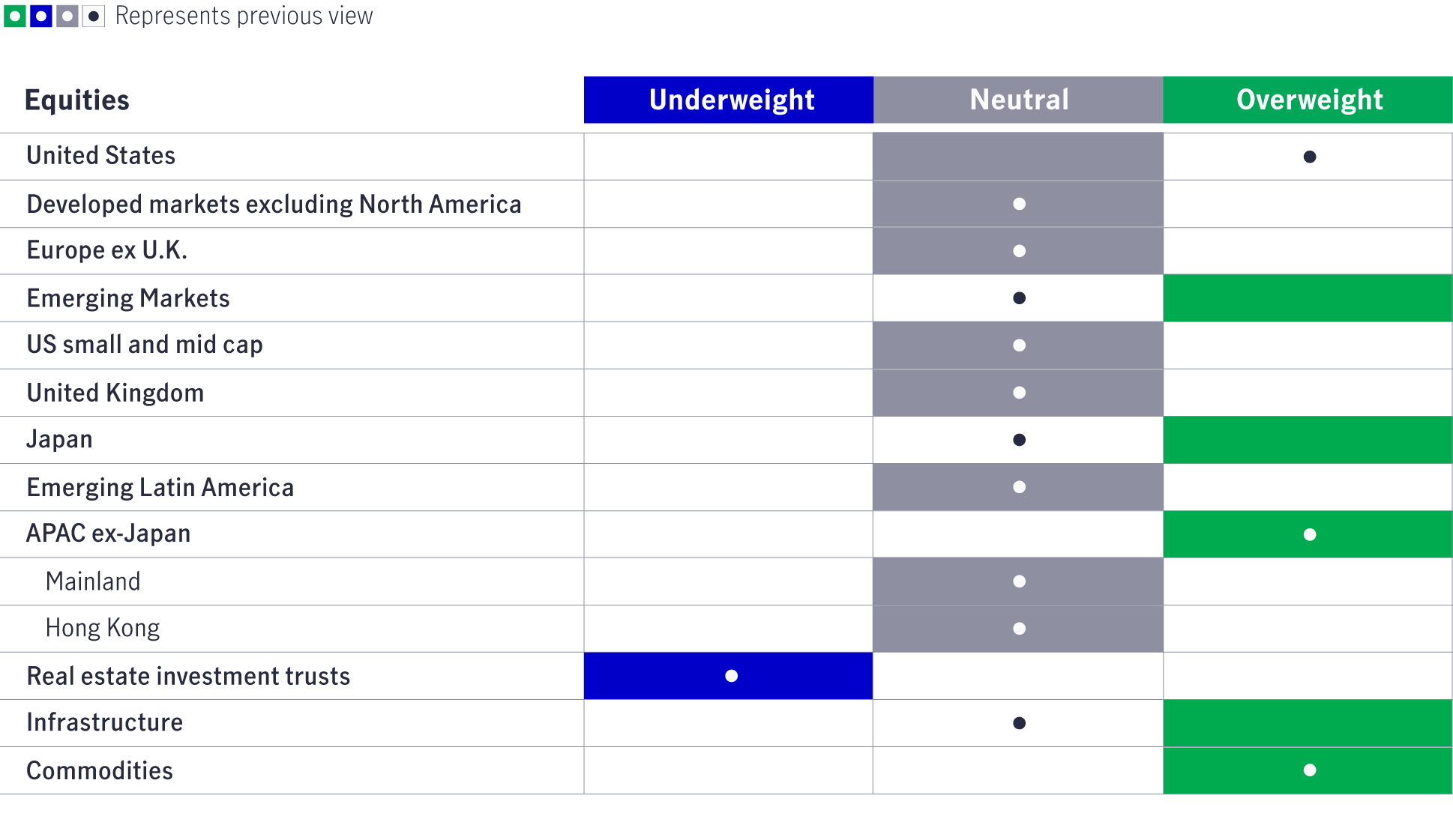
  • We’ve upgraded emerging Markets, Japan, Canadian, and infrastructure equities to overweight, and downgraded US equities to neutral.
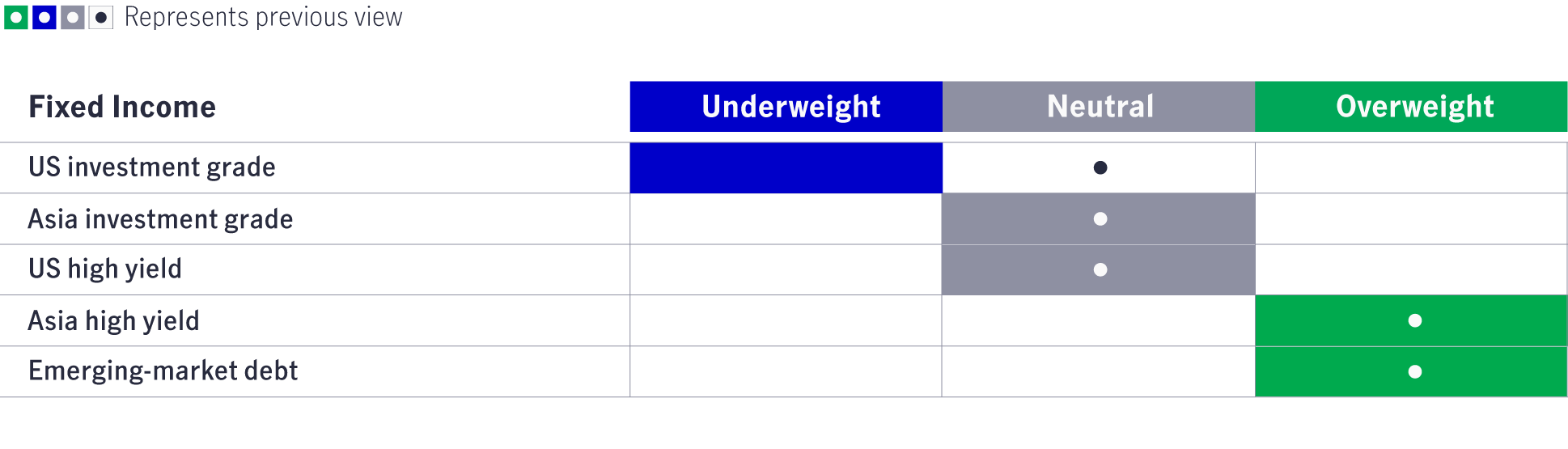
  • From a duration perspective, we continue to favour short and intermediate opportunities in the US, as longer-term assets have not provided portfolio defense amidst recent geopolitical turmoil, driven by oil-driven inflation concerns. 


Three forces shaping markets now—how to navigate macro uncertainty, the AI build‑out, and a smarter take on diversification


  • The only thing that’s clear about the conflict in the Middle East is that pinning down a neat timeline or clean forecast is impossible.

  • We’re currently assessing the conflict through three lenses: Time, infrastructure damage, and escalation. So far, the time portion has extended beyond what we would’ve assessed and we’re starting to see the conflict’s impacts filter through to macro data like inflation. The full extent of infrastructure damage remains to be seen but at the time of writing doesn’t appear to be irreversible, which is what’s allowing markets to continue treating the disruptions in the conflict as temporary.
     
  • We look at the conflict’s impact on growth and inflation more in terms of rank order than point estimate. To that end, North America is relatively well- sheltered, with Europe being slightly more affected. The emerging markets are being impacted more quickly, and with greater intensity.

  • Central banks have positioned themselves accordingly, with North American institutions willing to wait for evidence of secondary effects on inflation; Europe is slightly more wary; the UK and emerging markets have taken the most hawkish turn. 
  • AI isn’t acting like a classic bubble. The focus has shifted from hype to large‑scale investment in chips, data centers, and power systems, funded mainly by strong cash flow. Spending is still ahead of monetisation and near‑term productivity, but the build‑out continues.

  • Market leadership has become more selective. Strength is concentrated in enablers such as semiconductors, memory, power equipment, grid upgrades, and cooling. Some software companies are lagging as monetisation takes longer, deal cycles slow, and platform competition increases.

  • We remain positive but valuation aware. We focus on AI areas with clear earnings momentum and watch revenue scaling and power availability. With valuations elevated, earnings misses could trigger pullbacks, so we prefer disciplined position sizing and a balanced mix of quality growth, selective cyclicals, and value across equity markets.
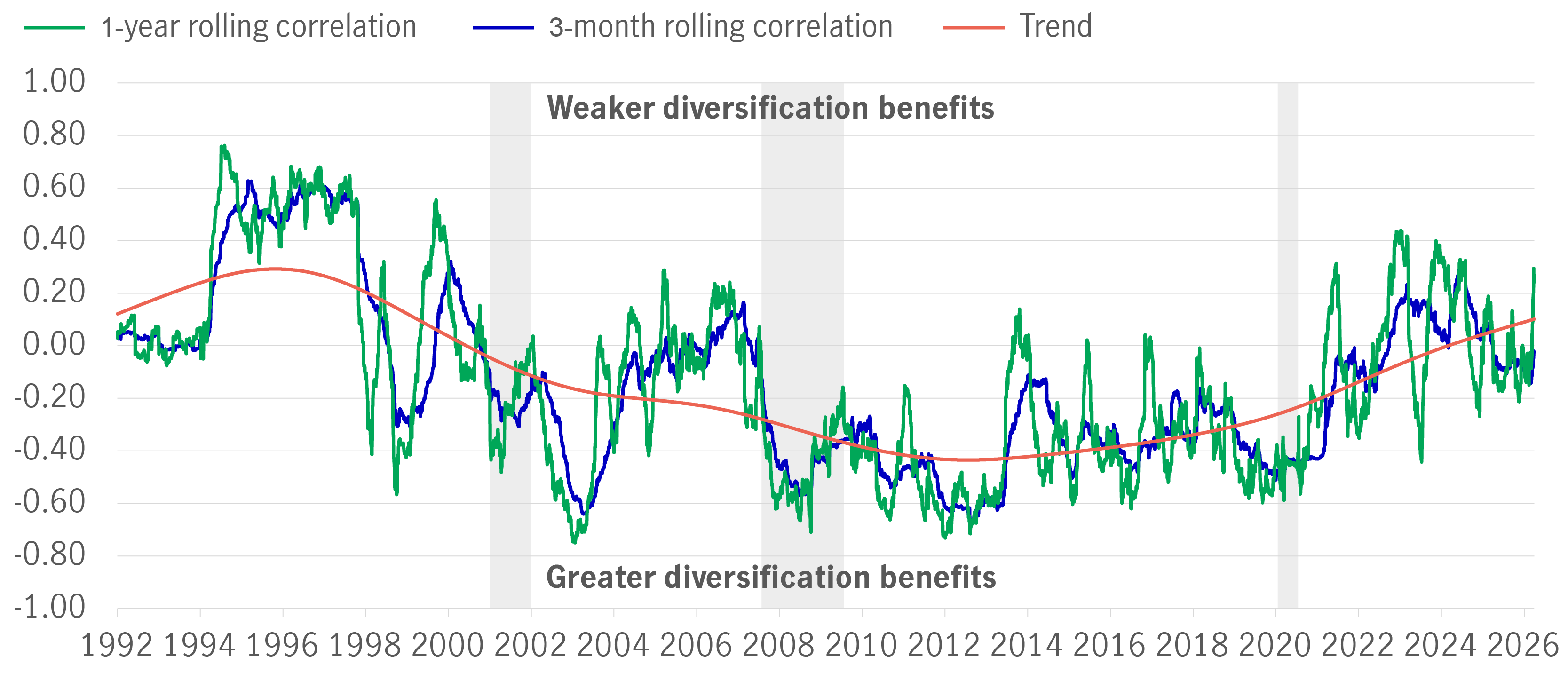
  • The traditional idea that bonds reliably hedge equities can weaken when inflation or geopolitics dominate. Recent tensions in the Middle East have pushed energy prices higher and kept bond yields from easing, even as equities softened. This underscores the importance of portfolios that draw on multiple sources of return instead of relying on a single hedge.

  • Equity opportunities are broadening globally. In the United States, elevated valuations support a wider mix across styles and market caps to help reduce concentration risk. Elsewhere, Japan, Europe, and parts of emerging markets offer selective opportunities. Conflict in the Middle East  have contributed to a pullback in non‑US equities and temporary US dollar strength, which may offer a chance to rebuild non‑US exposure as conditions stabilise.

  • We also see value in diversifiers beyond traditional stocks and bonds. Allocations to precious metals, liquid alternatives, and diversified real‑asset exposures can help support portfolio resilience when correlations between equities and bonds weaken, and traditional hedges become less reliable.

Broadening diversification amid an evolving market environment3

As stock-bond correlations rise, a wider toolkit can help investors navigate a shifting macro landscape

Equity and bond correlations have trended higher as inflation persists, long-term yields remain elevated, and structural forces such as deglobalisation, geopolitical tensions, fiscal expansion, and tariff policies exert pressure. This shift reduces the reliability of traditional diversification and heightens the need for broader sources of portfolio resilience.

Commodities can offer meaningful diversification, supported by structural strengths in both precious and base metals. Gold benefits from central bank and investors diversification demand, along with supportive currency and policy dynamics. Copper and aluminum should see long-term support from constrained supply, rising strategic importance, and demand tied to electrification, data centers, and industrial substitution.  Oil, while structurally challenged, presents a tactical opportunity so long as disruptions in the Strait of Hormuz continue to restrict global flows.

Alternatively, a more diversified mix of real assets, spanning real‑asset‑linked equities, inflation‑linked bonds, and commodities, can help investors weather structurally higher inflation, supply disruptions, and geopolitical fragmentation. Chronic underinvestment and rising long‑term demand from AI, electrification, and the energy transition further reinforce the case for these assets, which can also provide low correlations and durable income.

Liquid alternatives, including strategies like long‑short equity, market neutral, managed futures, and absolute return strategies, can complement equities and bonds by relying less on market direction and more on alpha, trend, and volatility dynamics. These strategies can help manage interest‑rate and equity‑market risk, improve drawdown resilience, and provide a smoother path of returns during periods of heightened uncertainty.

US Stock-Bond Correlation4
Copper treatment charges at record lows


1 Source: Manulife Investment Management, 31 March 2026. Projections or other forward-looking statements regarding future events, targets, management discipline or other expectations are only current as of the date indicated. There is no assurance that such events will occur, and if they were to occur, the result may be significantly different than that shown here. .No forecasts are guaranteed. These views are updated on a quarterly basis. This commentary is provided for informational purposes only and is not an endorsement of any security, mutual fund, sector, or index. Diversification does not guarantee a profit or eliminate the risk of a loss.

2 Source: Multi-Asset Solutions Team (MAST), as of 31 March 2026. Projections or other forward-looking statements regarding future events, targets, management discipline or other expectations are only current as of the date indicated. There is no assurance that such events will occur, and if they were to occur, the result may be significantly different than that shown here. Information about asset allocation view is as of issue date and may vary. Active asset allocation views will be updated on a quarterly basis.

3 Source: Multi-Asset Solutions Team (MAST), as of 31 March 2026. Projections or other forward-looking statements regarding future events, targets, management discipline or other expectations are only current as of the date indicated. There is no assurance that such events will occur, and if they were to occur, the result may be significantly different than that shown here.

Source: Bloomberg, Macrobond, Manulife Investment Management, as of 19 March 2026. Note: Shaded areas denote US recessions. Stocks are represented by the S&P500 Total Return Index. Bonds are represented by the Bloomberg US Treasury Total Return Index.