跳到主要内容
返回

Midyear 2026 Global Macroeconomic Outlook: trying to move past the Middle East conflict(暫時只有英文版,中文版將於稍後提供)

23 June 2026

Alex Grassino, Global Chief Economist, Multi-Asset Solutions

Dominique Lapointe, CFA, Senior Global Macro Strategist

Yuting Shao, Senior Global Macro Strategist, Multi-Asset Solutions Team

Hugo Bélanger, Senior Global Macro Analyst, Multi-Asset Solutions Team


Our midyear 2026 macro outlook highlights key themes across global economies and market implications for investors to consider in the second half of the year.

The ongoing Middle East conflict is still in the mix as a dominant macro theme as we enter the second half of 2026. At this stage, it’s fair to say that hostilities have lasted longer than most observers (ourselves included) would have predicted—and may or may not be completely over just yet.

A tentative mid-June deal between the United States and Iran could ultimately bring the conflict to a permanent conclusion, but many sensitive details have yet to be negotiated. For that reason, even if the American and Iranian blockades of the Strait of Hormuz are lifted soon, we have low conviction that commodities traffic through the region will resume swiftly, with some degree of geopolitical uncertainty likely to persist through the rest of this year.

What is clear is that the longer the geopolitical turmoil drags on, the greater the risk of adverse economic consequences. However, we can establish two things:

  • Not all global regions are being affected equally. Most notably, being a net energy exporter or failing that, at least being in possession of significant oil reserves, definitely emerged as a mitigating factor for some countries. The longer the conflict persisted, the more pronounced the divergence between economies with energy-export capacity and those more reliant on imports was becoming over time.
  • The worse the fallout, the more apt central banks will be to maintain or adopt hawkish stances. In mid-February, there was a narrative circulating that most central banks were “at or near their neutral policy rates.” With the passage of time, it got increasingly difficult for monetary policymakers to dismiss the conflict as a short-term disruption or a simple price shock—second-order inflation effects were beginning to creep into forecasts, driving a more hawkish bent across most regions.

United States: still strong amid reshuffled deck


Like elsewhere globally, the Middle East conflict altered the U.S. macroeconomic picture to some extent. That said, the impact on U.S. growth and inflation appears limited relative to other regions, reflecting the country’s position as a net energy exporter and other growth drivers still in place.

Beneath the geopolitical uncertainty, the overall macro backdrop is constructive. Earlier this year, our outlook pointed to the likelihood that easier monetary policy and fiscal support would provide strong underpinnings for the U.S. economy. There is, in fact, evidence of broadening economic activity despite the overseas conflict: Industrial production and business investment have strengthened, while consumption remains resilient. Barring a meaningful deterioration in the labor market or a sustained downturn in capital markets, consumer spending should continue to bolster growth.

We don't expect the U.S. Federal Reserve (Fed) to lower rates absent sustained improvement in supply-side pressures. Indeed, with growth solid, labor holding up, and inflation elevated, the case for easing has weakened and would likely only regain traction if the Fed saw signs of disinflation, or at least stable inflation combined with softness in either growth or labor. At the same time, Fed tightening seems unlikely unless the conflict re-intensifies and extends well into the third quarter, which would rekindle inflationary concerns. Once supply-chain constraints loosen, the Fed may resume its path toward its long-run neutral rate (~3.1%).

What we’re watching

There are nascent indications of incremental improvement in the jobs market, which could undercut any arguments for Fed easing. If employment tightens materially—a distinct possibility, given today’s underlying labor supply dynamics—the Fed’s scope to ease could diminish, perhaps shifting its policy stance more hawkish.

Market implications

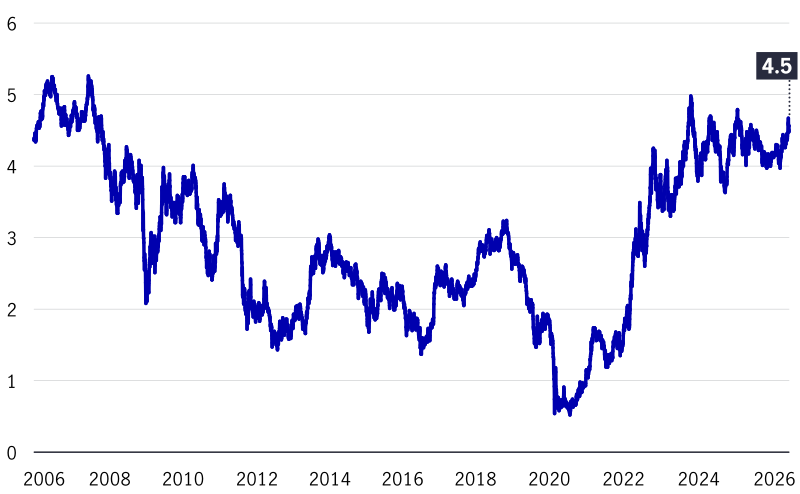
Our focus remains on the long end of the yield curve. Earlier this year, falling yields hinted at a potential mortgage-refinancing wave that might boost growth. Now, rising yields pose the opposite risk: A sustained increase could begin to weigh on U.S. equity market performance and financial conditions.

Rising bond yields could pose a headwind to U.S. growth and markets
10-year U.S. Treasury yield (%)

10-year-us-treasury-yield

Source: U.S. Treasury, New York Federal Reserve Bank, Macrobond, Manulife Investment Management, as of 28/5/26.

China: “K-shaped” growth likely to persist


Solid first-quarter GDP growth has put China on track to meet its 4.5-5.0% growth target for 2026, although we expect momentum to moderate as the year progresses. Notably, China’s “K-shaped growth” —where the economy is based heavily on high-end manufacturing, capital expenditures, and strong exports, while domestic sectors generally lag—is likely to continue.

On inflation, while China’s Producer Price Index (PPI) has turned positive (driven by higher import prices amid elevated energy costs and strong AI demand), weak domestic consumption underpins muted pass-through effects to headline and core readings. This dynamic could weigh on producers’ profit margins and raise questions about the sustainability of reflation and implications for China’s equity market. That said, despite the imbalances in the economy, Chinese assets have held up well throughout the Middle East conflict. Diversification in energy dependency has helped to cushion the shock, as have oil-price controls and ample inventory levels.

Looking ahead, with growth broadly on track to meet target, Chinese leaders are preserving policy flexibility for now and appear to be in no rush to push for additional economic stimulus. However, should downside risks materialise, policymakers are well-positioned to adjust their approach accordingly.

What we’re watching

China’s equity outperformance observed over the past year has started to fade, especially relative to its North Asian peers, amid a confluence of headwinds, including a lack of meaningful savings reallocation into the market and underweight positioning in China on the part of foreign equity investors. We will be closely monitoring whether the second half of 2026 ushers in a more constructive backdrop for the equity market.

Market implications

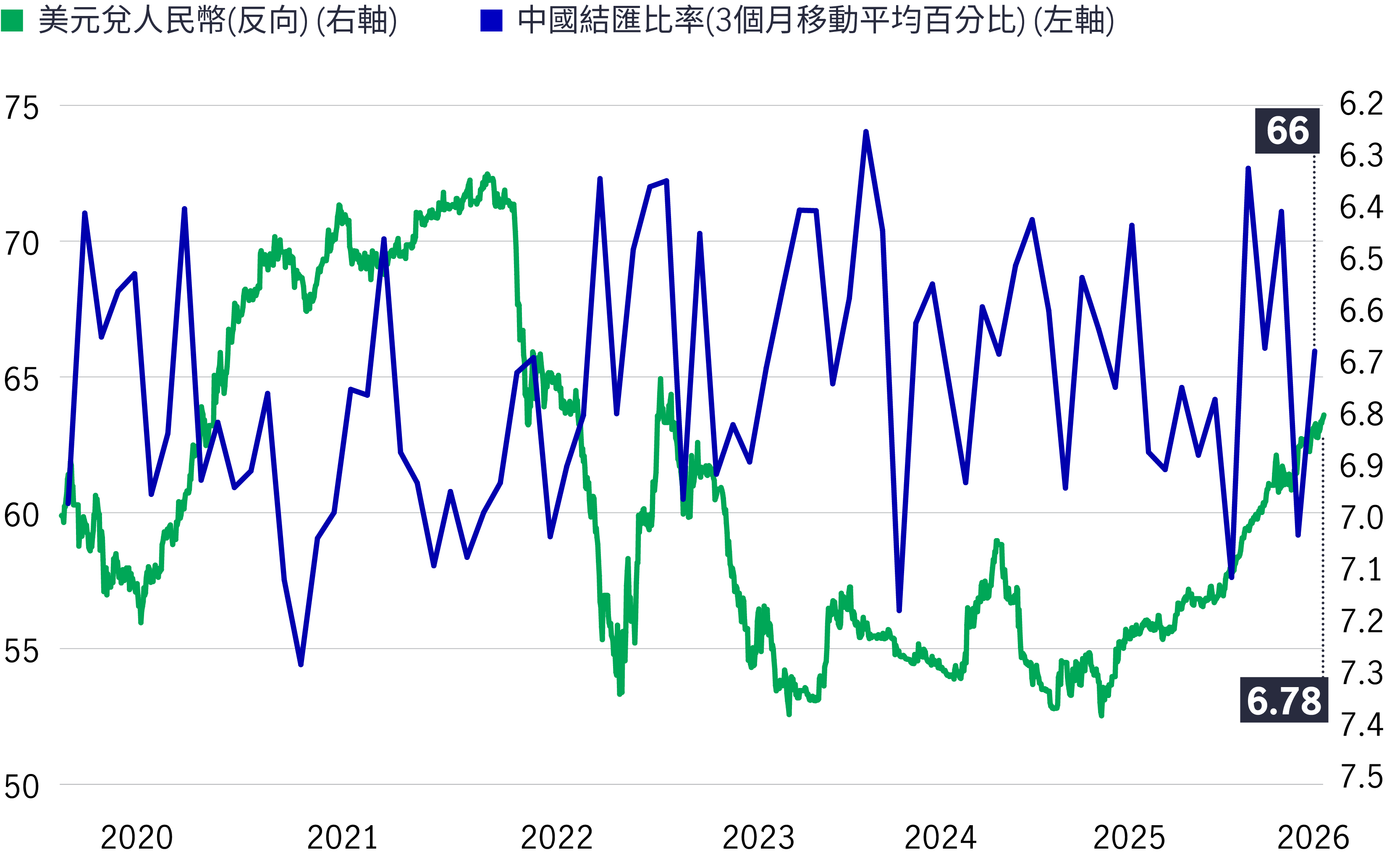
We expect the Chinese yuan to remain resilient going forward, supported by the country’s strong trade surplus and corporate currency-conversion flows.

China’s currency settlement ratio has trended higher, suggesting a resilient yuan

china-currency-settlement-ratio

Source: Bloomberg, Macrobond, Manulife Investment Management, as of 28/5/26. “USD” and “CNY” stand for U.S. dollar and Chinese yuan, respectively; “FX” stands for foreign currency exchange. Currency settlement ratio refers to the proportion of international trade or foreign exchange (FX) transactions that are settled and cleared using a specific currency.

Europe: fiscal tailwind vs. energy headwind


At the beginning of 2026, we were broadly constructive on the euro area, supported by a stronger fiscal impulse, ongoing structural reforms, improving credit growth, and a fairly stable external backdrop.


However, because the Eurozone is a net energy importer with relatively high energy expenditures, the Middle East conflict clouded our outlook. As such, unless flows through the Strait of Hormuz return to normal quickly, economic growth—particularly the consumer spending component—may be affected, likely offsetting some of the boost from Germany’s defense and infrastructure spending. While our current economic assumptions do not point to a recession, they do imply weaker growth.

That said, this year’s oil price shock differs from the 2022 energy crisis, which was amplified by natural gas supply distortions feeding directly into electricity prices. That factor isn’t really in play this time around: The more recent situation is more about oil products, so the overall impact will probably be smaller, albeit still a headwind. Further mitigating the price shock are softer labor-market dynamics, which should reduce the risk of wage-driven second-order effects.

With the European Central Bank’s (ECB) policy rate already within the estimated neutral range, policymakers will need to balance lower growth and higher inflation. Given that delicate balance, we don’t expect the ECB to undertake an aggressive tightening cycle unless it sees clear evidence that long-term inflation expectations are becoming unanchored, or that wage growth is reaccelerating. We therefore view the latest market expectations of multiple ECB rate hikes as being premature.

What we’re watching

Whether or not the deal to end Middle East conflict proves lasting will ultimately drive the magnitude and persistence of the inflation/growth shock. The ECB’s responses will likely hinge on evolving inflation expectations and wage dynamics.

Market implications

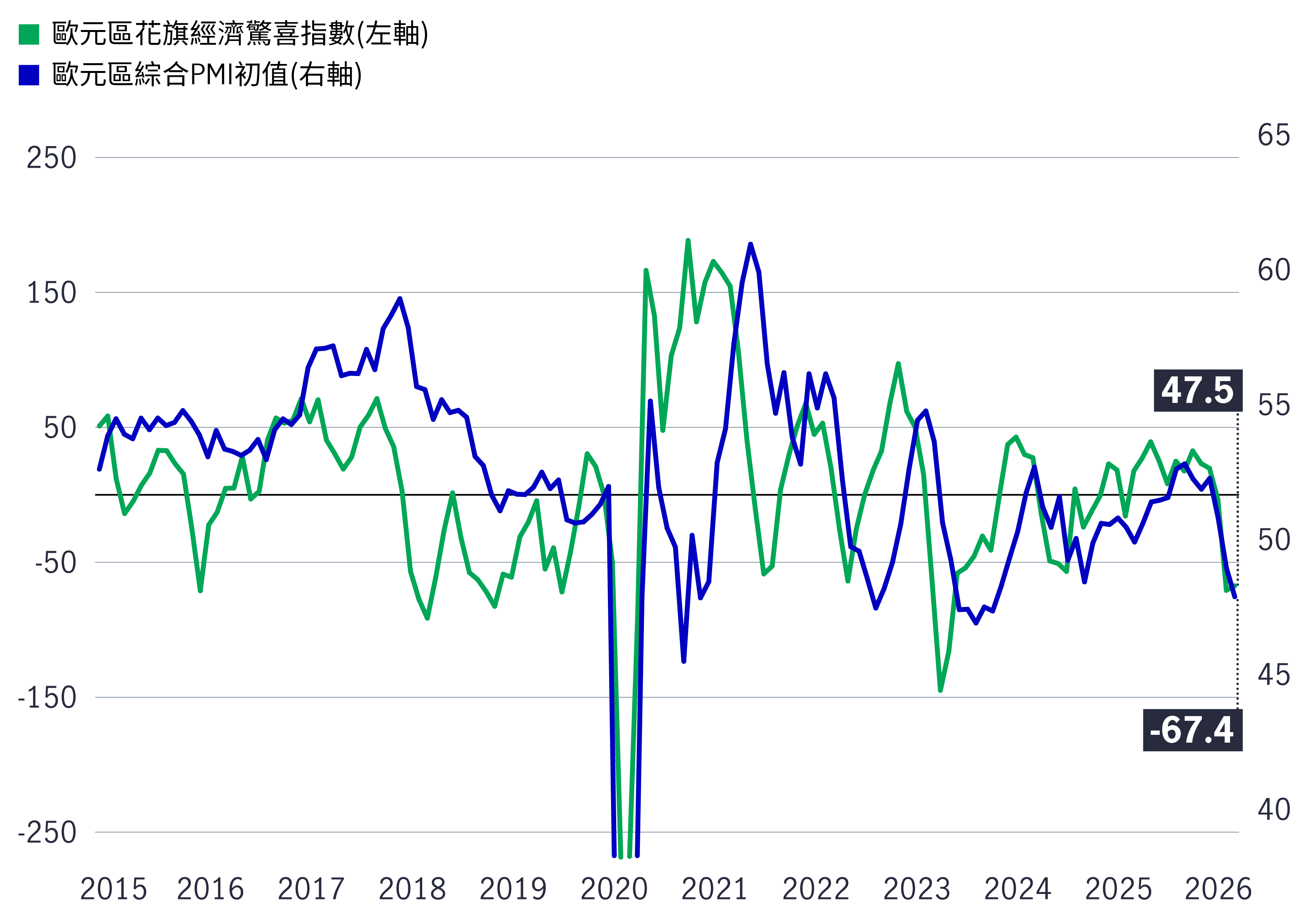
European equities may remain under some pressure until there are no further shipping disruptions in the Strait continue. Amid inflation concerns, markets are already pricing in several ECB rate hikes, but weaker growth should limit the ECB’s scope to tighten.

Risks to euro area growth are mounting, as evidenced by recent indicators

euro-area-growth-risk-mounting-indicators

Source: S&P Global, Macrobond, Manulife Investment Management, as of 21/5/26. The Citigroup Economic Surprise Index (CESI) tracks whether a core set of economic data series has been coming in below, at, or above expectations. The Euro Area Flash Composite Purchasing Managers’ Index is an economic indicator that measures the overall health of the private sector in the Eurozone, combining both the manufacturing and services industries. It is not possible to invest directly in an index.

United Kingdom: growth still under pressure


Despite stronger-than-expected first-quarter data, the United Kingdom’s (U.K.) economic growth is likely to stay subdued through 2026. Elevated energy prices and tight financial conditions have dampened both consumer demand and business investment, while monetary and fiscal support remain limited.

On monetary policy, the energy shock may have forced the Bank of England (BoE) to maintain a more hawkish stance. However, imminent rate hikes (currently priced in by markets) are not our base case because labor market dynamics are softening, with easing wage pressures limiting broader inflationary impacts. Moreover, U.K. monetary policy is already more restrictive than in other developed markets. Before the oil shock, markets expected the BoE to cut rates; subsequent repricing pushed the long end of the yield curve higher, feeding through to rising average mortgage rates and further squeezing households.

On fiscal policy, fragile public finances and heightened political uncertainty imply a tighter stance ahead. The energy crisis eroded some fiscal space by raising interest rates and lowering growth prospects. Meanwhile, the U.K. could soon see yet another change in leadership, continuing a revolving door of prime ministers in recent years, with the potential for a leftward shift toward more expansionary policies weighing on bond markets. Notably, U.K. gilt markets are constraining the government’s ability to provide fiscal support and tightening financial conditions across the economy.

What we’re watching

A rapid growth slowdown could pull forward BoE rate cuts, while clearer second‑round inflation effects could reinforce monetary tightening expectations. A new political regime could materially influence market sentiment.

Market implications

Gilt yields look poised to stay higher for longer. Markets appear too hawkish on BoE policy tightening. U.K. equities are likely to underperform most developed-market peers.

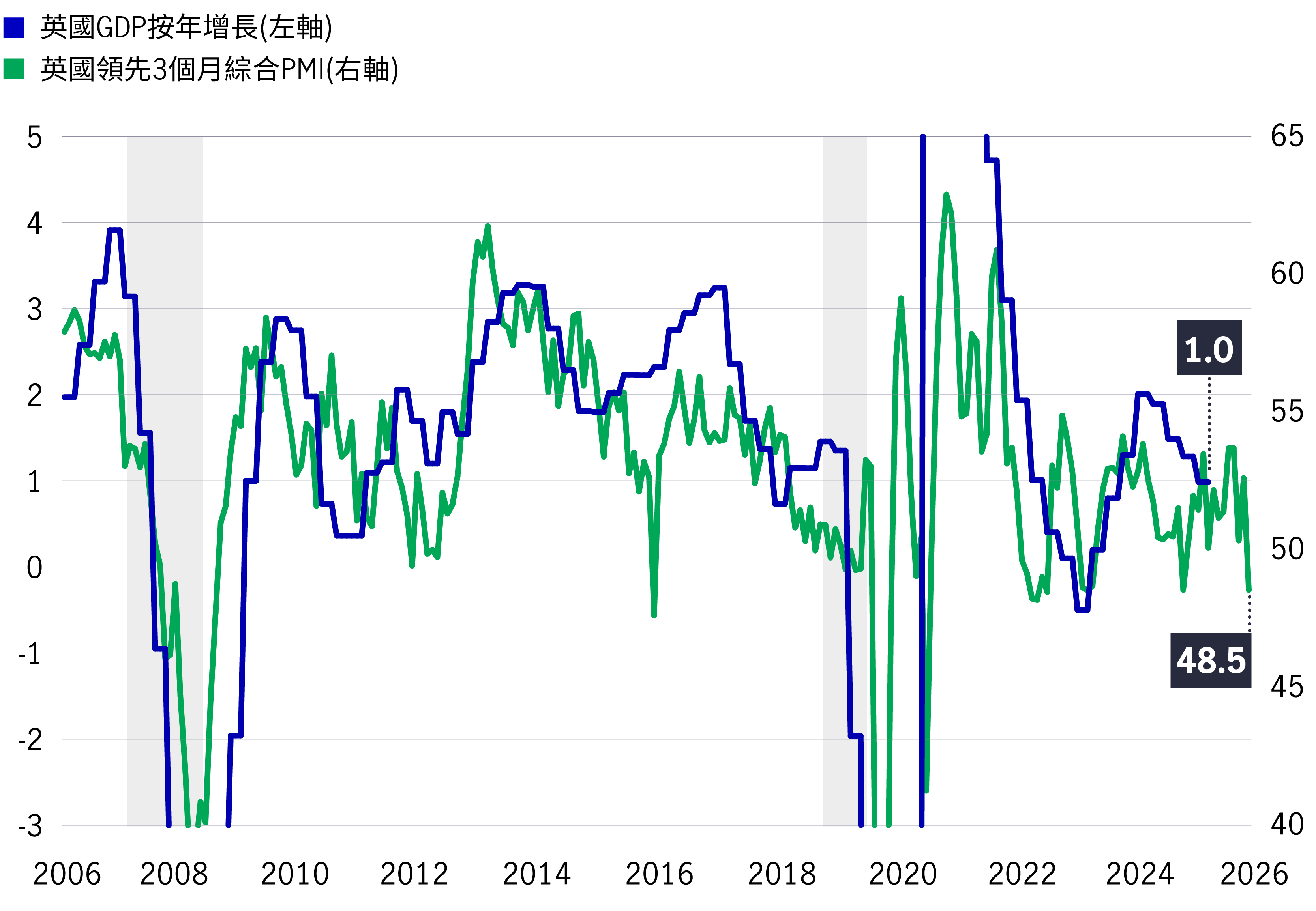
The United Kingdom’s PMI points to potentially softer GDP growth ahead

uk-pmi-versus-gdp-growth

Source: S&P Global, ONS, Macrobond, Manulife Investment Management, as of 26/5/26. “GDP” stands for gross domestic product; “YoY” stands for year-over-year. The U.K. Composite Purchasing Managers' Index (PMI) is a key economic indicator designed to provide a comprehensive, real-time snapshot of overall private sector business conditions and economic growth in the United Kingdom. It is not possible to invest directly in an index.

Japan: a structurally positive outlook


Despite a robust first-quarter print, we expect Japan’s real GDP growth to face near-term headwinds going forward. Deteriorating terms of trade, driven by higher energy prices and a weak yen, have posed upside risks to inflation and downside risks to growth. This potential stagflationary backdrop may afford the Bank of Japan (BoJ) some policy flexibility to “stand pat” on interest rates, as it awaits more data clarity on the global economic and geopolitical picture before proceeding with further rate hikes.


Meanwhile, Prime Minister Takaichi’s decisive victory in the snap election earlier this year, gaining a critical supermajority in the Lower House, has given the Japanese ruling coalition a strong mandate to pursue expansionary fiscal policy in support of the economy. This pro-growth stance, coupled with resilient global trade, underpins our structurally positive growth outlook over the medium term, even as we closely monitor economic and geopolitical developments in the second half of 2026.


What we’re watching


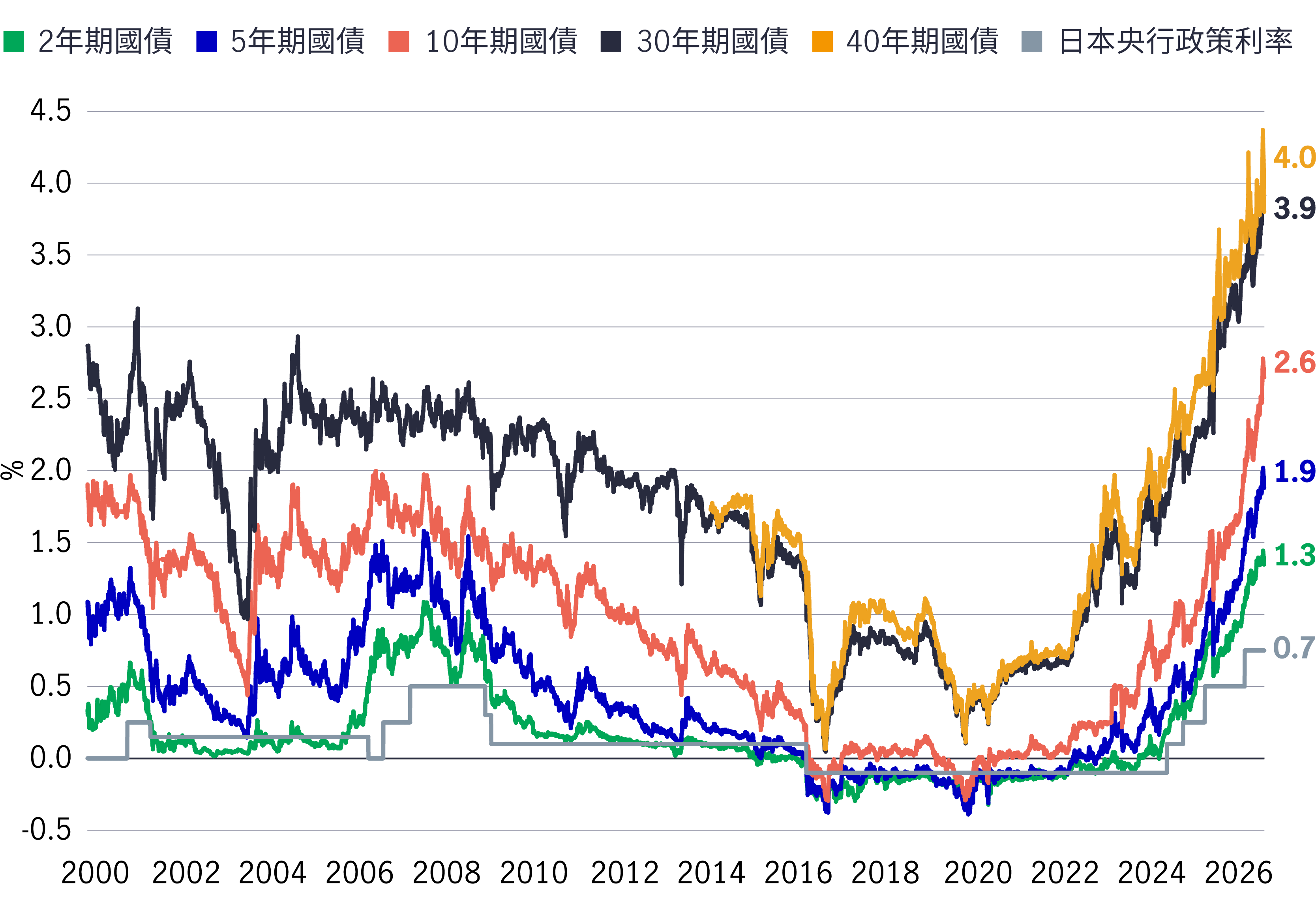
Japanese government bond (JGB) yields have risen to multidecade highs amid higher domestic inflation, BoJ rate-hike expectations, and deficit spending by the government. A new supplementary budget could fuel renewed concerns over JGB issuance and fiscal discipline.

Market implications

The yen may fall victim to the Japanese-style “impossible trinity,” meaning that a combination of expansionary fiscal policy, accommodative monetary policy, and a resilient currency likely cannot be sustained in practice. Despite recent intervention by the Japanese Ministry of Finance, the currency’s struggles may continue unless we see a meaningful reversal of the yen carry trade and a sharply hawkish policy shift by the BoJ.

Japanese government bond yields have risen sharply in recent months

japan-government-bond-yield

Source: Bloomberg, Macrobond, Manulife Investment Management, Bank of Japan, as of 27/5/26. “JGB” stands for Japanese government bond; “BoJ” stands for Bank of Japan.

EMs: navigating stagflation risks


Emerging-market (EM) economies have demonstrated notable resilience in the face of the energy price shock, with GDP downgrades thus far relatively contained. Looking ahead, while geopolitical uncertainties could continue to dampen the outlook, several supportive factors might help cushion the negative impact on economic growth.


Tariff and other policy uncertainties have eased from the peaks of “Liberation Day” 2025, buoying global trade volume and overall market sentiment. In addition, the ongoing AI/technology supercycle continues to underpin robust global demand. Fiscal policy across many EMs, while undergoing gradual consolidation to rebuild buffers, remains sufficiently flexible to deliver targeted support where needed.


That said, the outlook across EMs may become increasingly bifurcated in the coming months, especially if we don’t see a rapid end to the Middle East conflict: Energy exporters and economies benefiting from AI-driven growth may outperform energy importers and structurally constrained economies with limited exposure to AI tailwinds.


What we’re watching

The rising threat of inflation, including second-round impacts on core readings and inflation expectations, combined with a slower growth outlook, put most EM central banks in a difficult position. While conventional wisdom calls for policymakers to look through exogenous shocks, deteriorating terms of trade and higher inflation pass-through risks may have triggered a dangerous feedback loop that could exacerbate currency weakness and weigh on growth.

As such, many EM central banks’ policy stances have turned hawkish. We will continue to monitor how their responses might diverge as they navigate the challenge of managing stagflation risks.

Market implications

Sustained EM equity outperformance will depend on a softer U.S. dollar, the continuation of the AI cycle, and a durable manufacturing and trade backdrop.

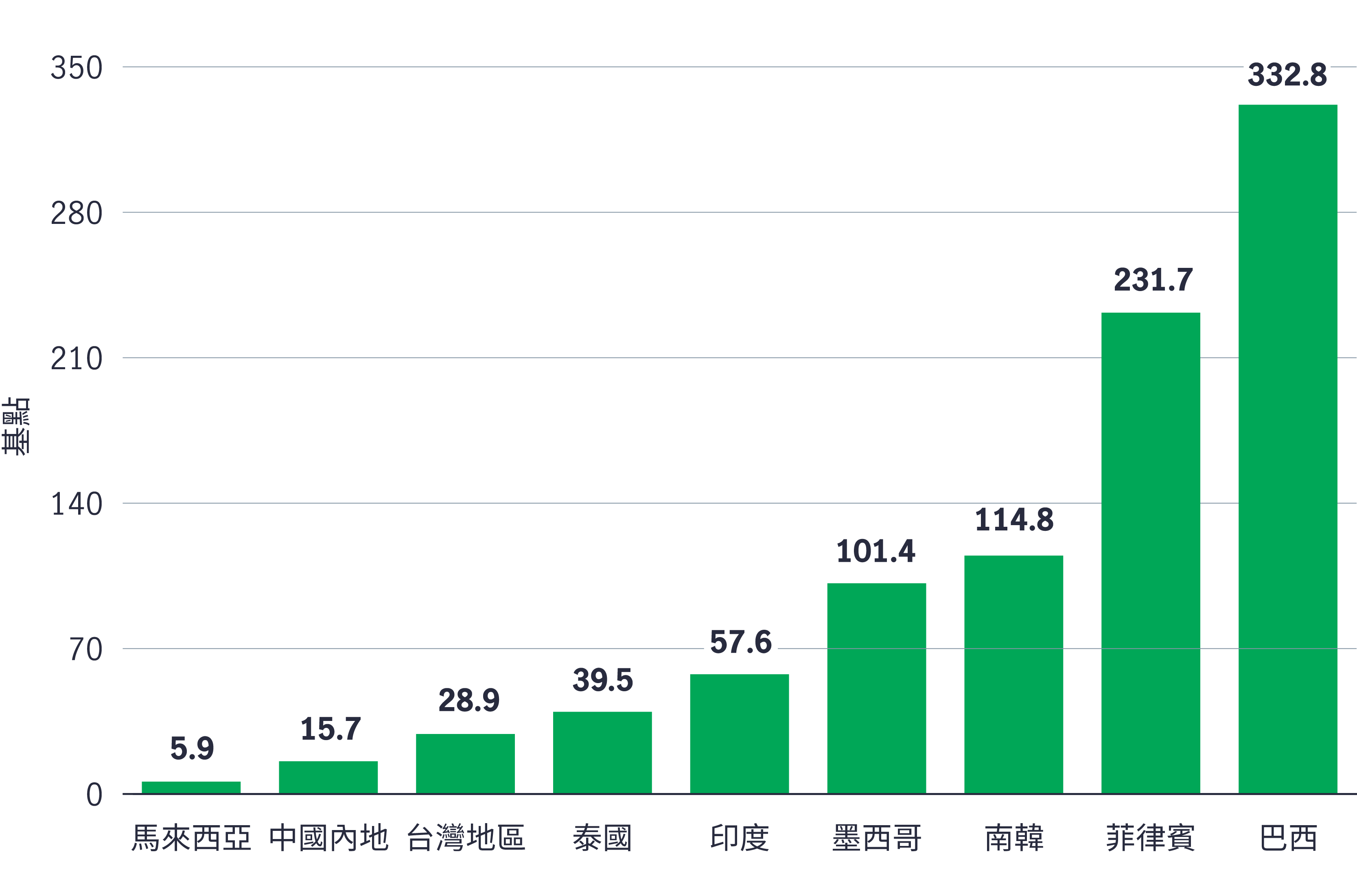
Many EM central banks are expected to hike rates in the months ahead
1-year forward implied policy rate changes

em-central-banks-1-year-forwrd-rate-changes

Source: Bloomberg, Macrobond, Manulife Investment Management, as of 26/5/26. One-year forward implied policy rate changes shown are since 27/2/26. A basis point (bp) is a unit of measure equal to 1/100 of one percent, or 0.01%. For example, 100 basis points are equal to one percentage point (1.0%).

Canada: a recovery on a short leash


Though Canada started 2026 with weak momentum, signs of stabilisation emerged as some businesses began to adapt to U.S. sectoral tariffs still in place on steel, aluminum, autos, and other goods. However, a new complication arrived in March: The Middle East conflict drove oil prices above US$100/barrel, pushing Canada’s headline inflation to 2.8% in April, even as core measures eased to around 2%.

The Bank of Canada (BoC) now faces an uncomfortable balancing act: Hold rates steady at 2.25% to support a soft labor market (with the unemployment rate currently at 6.6%), or resume hiking if global energy prices don’t come down all that much and begin feeding into broader domestic inflation—a risk that BoC Governor Macklem has explicitly flagged.

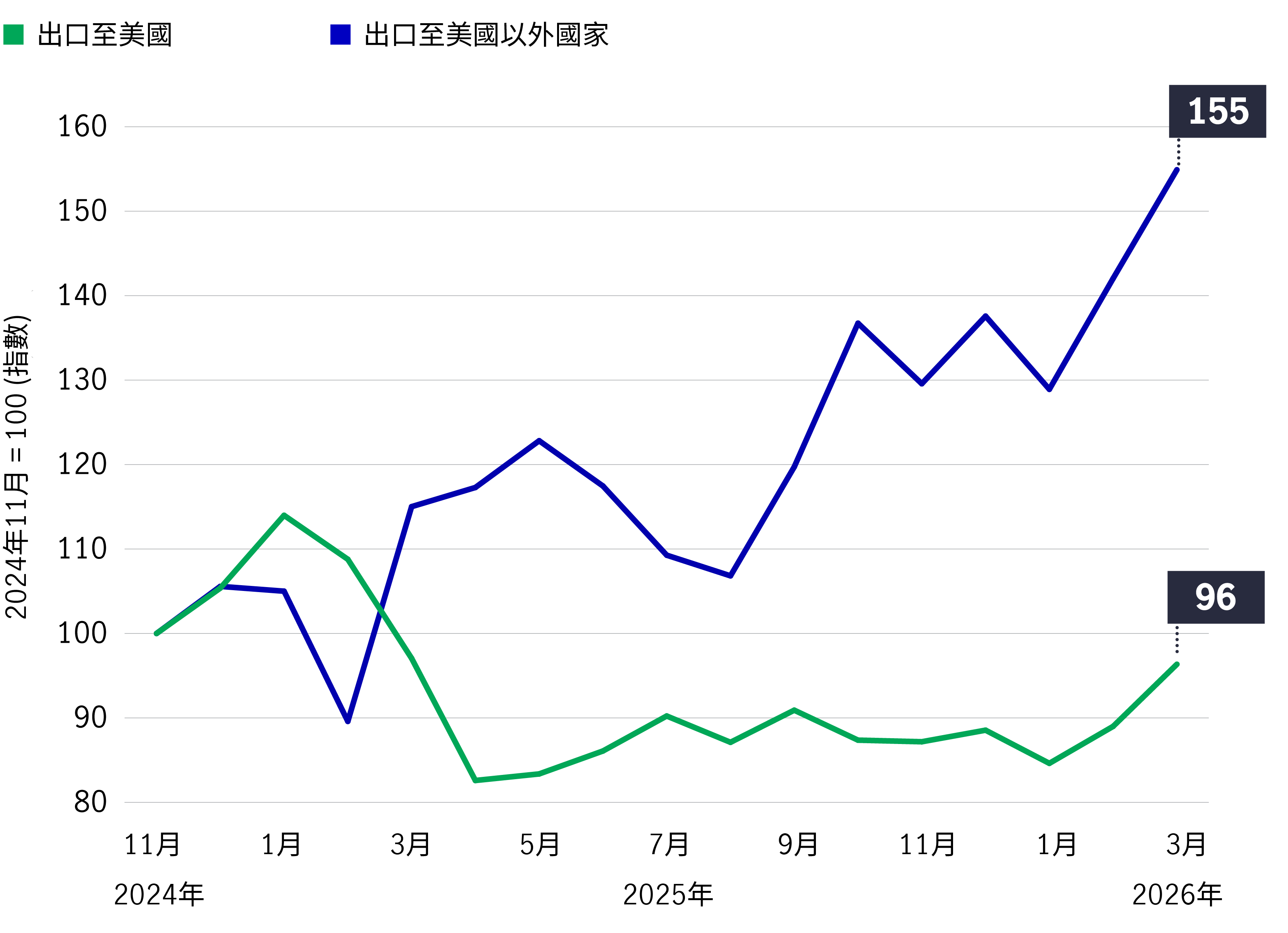
Despite the unforeseen energy shock, we think the Canadian economy will grind through the year with sluggish but positive growth. Government spending on infrastructure, housing, and tax breaks to consumers is doing the heavy lifting so far. Non-U.S. exports have picked up slightly, although the gains are concentrated primarily in energy and gold, not in manufacturing.

Bottom line: We forecast full-year GDP growth of roughly 1.0%, with gradual acceleration into 2027.

What we're watching

The United States-Mexico-Canada Agreement (USMCA) formal review starts on 1 July. While a deal is still possible, differences in trade positioning between Canada and the United States seem to have widened in recent months. The risk that Canada may face higher broad-based tariffs by the end of the year has therefore risen.

Market implications

The S&P/TSX Composite Index has advanced roughly 11% year-to-date. We expect returns to moderate as energy tailwinds fade, but financial and materials companies should continue to perform well. Fixed-income returns may be muted with the BoC on hold and long-term U.S. Treasury yields higher. The Canadian dollar could appreciate modestly on narrowing rate differentials and higher commodity prices, but weak growth and USMCA uncertainty may cap any gains.

Canadian exports to the U.S. have fallen, partly offset by rising exports elsewhere

canadian-exports-to-us-and-elsewhere

Source: StatCan, Macrobond, Manulife Investment Management, as of 28/5/26.


  • 最新資產配置觀點(2026年第二季)

    2026年第二季最新資產配置觀點的三大關鍵環球主題:1. 應對宏觀不確定性、2. 把握人工智能建設推進、3. 更精明的角度進行分散投資。雖然估值水平、通脹壓力及更廣泛的地緣政治不確定性仍構成持續風險,但整體宏觀環境仍偏向有利於風險資產。

    閱讀更多
  • 2026年亞太房託展望:由減息紓緩邁向增長復甦

    亞太區(日本除外)房地產投資信託基金(亞太房託)於2025年表現理想,展望2026年有望迎來關鍵轉捩點 — 由減息帶動的紓緩期過渡至增長復甦階段。在本期《2026年前景展望》中,投資組合經理黃惠敏及Derrick Heng將深入剖析利率下調如何為亞太房託開啟兩大增長動力 — 一方面透過節省利息成本推動內部增長,另一方面透過資本循環帶動併購增長。同時,團隊亦會分析歷史相對估值優勢及區內交易所政策利好等催化因素,如何進一步提升亞太房託的投資吸引力,並分享團隊於新一年看好的行業板塊。

    閱讀更多
  • 2026 年前景展望系列:環球股票多元入息

    展望2026年,主導股市上升的動力可能擴展至超大型科技股以外領域,為不同行業及地區創造投資機遇。受惠於主要市場的財政開支及寬鬆貨幣政策,預期環球經濟增長將趨於穩定。歐洲及個別亞洲經濟體的估值具吸引力,而且基本因素持續改善,與美國市場的韌性相輔相成。在良好基本因素支持下,除了增長型投資風格外,以價值和收益為本的策略或再度成為焦點。環球股票多元入息策略致力把握機遇,分散投資於不同地區、行業和風格,旨在爭取收益及資本增值。

    閱讀更多
查看全部
  • 最新資產配置觀點(2026年第二季)

    2026年第二季最新資產配置觀點的三大關鍵環球主題:1. 應對宏觀不確定性、2. 把握人工智能建設推進、3. 更精明的角度進行分散投資。雖然估值水平、通脹壓力及更廣泛的地緣政治不確定性仍構成持續風險,但整體宏觀環境仍偏向有利於風險資產。

    閱讀更多
  • 2026年亞太房託展望:由減息紓緩邁向增長復甦

    亞太區(日本除外)房地產投資信託基金(亞太房託)於2025年表現理想,展望2026年有望迎來關鍵轉捩點 — 由減息帶動的紓緩期過渡至增長復甦階段。在本期《2026年前景展望》中,投資組合經理黃惠敏及Derrick Heng將深入剖析利率下調如何為亞太房託開啟兩大增長動力 — 一方面透過節省利息成本推動內部增長,另一方面透過資本循環帶動併購增長。同時,團隊亦會分析歷史相對估值優勢及區內交易所政策利好等催化因素,如何進一步提升亞太房託的投資吸引力,並分享團隊於新一年看好的行業板塊。

    閱讀更多
  • 2026 年前景展望系列:環球股票多元入息

    展望2026年,主導股市上升的動力可能擴展至超大型科技股以外領域,為不同行業及地區創造投資機遇。受惠於主要市場的財政開支及寬鬆貨幣政策,預期環球經濟增長將趨於穩定。歐洲及個別亞洲經濟體的估值具吸引力,而且基本因素持續改善,與美國市場的韌性相輔相成。在良好基本因素支持下,除了增長型投資風格外,以價值和收益為本的策略或再度成為焦點。環球股票多元入息策略致力把握機遇,分散投資於不同地區、行業和風格,旨在爭取收益及資本增值。

    閱讀更多
查看全部
重要通知

由2026年7月2日起,宏利投資管理(香港)有限公司的客戶服務中心將遷至香港九龍觀塘海濱道83號宏利大樓23樓。此中心提供與宏利智晰投資服務帳戶、宏利盈進基金SPC、宏利環球基金及 宏利香港系列有關的客戶服務。敬請於到訪前致電客戶聯絡中心2108 1110進行預約。

了解更多